My watch read 2hours and 52 minutes. This meant that, by my own volition, I had been running through the woods on my own two feet for a very long time. Even more surprising than the fact that my legs hadn't crumpled yet was the realization that I was fairly perky and still smiling at hikers and bikers I passed along the way. After three hours of hard continuous exercise and elements, it's an annoying discovery about oneself.
After greeting a group of cyclists with a hearty "Good morning!" while my heart monitor beeped rapidly, I admitted inwardly that I had become that person--the one whose cheeriness agitates others. For me, that person, the one whose enjoyment of arduous long distance events never faltered, was a well-groomed gentleman named Steve Rojek. In recent years, this decorated equestrian has represented the U.S. in international endurance racing. I first encountered Mr. Rojek competing in competitive trail rides around central Vermont in my adolescence. He had a reputation for remaining so upbeat during rainstorms, fatigue, bee stings, and other trail maladies that it irritated the rest of us mortals. Primarily, his bionic good nature highlighted the fact that the rest of us were...well, not very good natured after mile 20. Our spirits sagged, our energy failed, and our smiles turned to crabby exchanges, leaving us just plain puzzled by guys like Mr. Rojek. I've used the plural "guys" there, but I should clarify that there was only one rider as invincible as Mr. Steve Rojek.
In one event so predictably difficult that we called it the Hartford Heartbreak 40 miler, we hit rain, snow, mud, and ice all in one morning. At mile 12 my mare refused to cross a river that swelled overnight to frightening heights for a pony, so I dismounted and entered the water to reassure her. For the next several miles, my cold wet breeches chafed my calves raw. The overnight rain also knocked down trail markers between miles 16 and 22, which meant most of us added an unnecessary loop to climb Heartbreak Hill TWICE.
After the second 800-foot ascent, my tired mare's pulse and respiration inverted. Veterinarians put us on mandatory hold while she puffed and puffed and finally recovered. It was about this time that Mr. Rojek crested Heartbreak Hill on his dappled grey Arabian gelding. His tailored pale blue shirt now bore a swath of blood across one sleeve and his neatly trimmed mustache showed a clump of mud. The visor of his helmet, too, was cracked and muddy, the evidence I heard later of his horse bolting across the river and scrambling madly up a bank into oncoming traffic on Route 12A. En route, the horse launched Mr. Rojek into a rock-strewn stretch of trail and galloped two miles towards the nearest town before someone caught him.
Nonetheless, Mr. Rojek was smiling. His was a genuine smile, too, I should add, not an act he feigned for the rest of us. Something about the gnarly mishaps of the day agreed with him. He loped past the vet station where I stood pouting and flashed an open-palm wave. "Lovely day, isn't it?" he called out on his way to tackle more miles, the pursuit that brought this man so much solace.
I looked at a fellow competitor who withdrew from the ride mid-way due to knee pain. We puzzled over the complete lack of sarcasm in Mr. Rojek's salutation. What on earth could be so lovely about this? For years I pondered over that as I encountered Mr. Rojek out on the trail. Always-- at mile 18, mile 47, mile 92-- his face came through the fog and downpours and snow with a grin. When you're on the other side of that grin, mired in the difficulty of your endeavor, you start to wonder if the person might be alien. When you are aching, tired, and hungry, how can the person next to you still be smiling?
Then I became an adult myself and took up sports like marathoning, bike touring, and yes- still long distance trail riding. These long miles out in Mother Nature agree with me on every level and, while I hate to admit it, I have become a version of Mr. Rojek. Finally, I understand the man who puzzled me for ages. Now, I too annoy others with a hearty wave and toothy grin. As others grunt and gasp up hills, I waste extra energy reflecting on the sweet smell of eucalyptus in the woods at this time of year. I incite annoyed looks from others on the trail.
Let me be clear. It's not that I don't feel the suffering or the sheer effort or overwhelming fatigue to get to the next mile. I do. When my watch approached 3 hours last Sunday, though, the small details of my discomfort paled beside my solace and satisfaction of long distance in the woods. The larger joys far outweighed my flaming ankle, crampy calves, and thirst. I ached and fatigued just as much as anyone on the trail that day, don't be fooled by the grin and don't start wondering if I am alien.
For some of us, long distance nourishes our souls. Tired legs and sore knees aside, it is the antidote to our busy minds, the peace inside us. Our smile despite the discomfort.
So, Mr. Rojek, I raise my electrolyte filled glass to you. Thank you for being an early inspiration and please forgive any annoyance I sent your way. Ride on!
Thursday, March 8, 2012


Friday, December 23, 2011
Merry Christmas, Tree
My favorite Christmas tree remains the one that got away.
All these years later, I long for its perfect shape and just-right pine needle scent. Just like the bad boy in high school whose handsome looks and charm were bolstered by the fact that he never became my boyfriend, this particular Christmas tree was one of life's flirty objects that resisted ownership. And, oh, how it broke my heart that winter, my 11-year old self bawling with a conviction reserved for devastating events. How it broke my heart that, even though the tree had been chosen and cut by us and therefore should have been erected in the Ballou home, it never got close to our living room. How it broke my heart the way it splintered and snapped into clumps of green across the half mile from the woods' edge to our barn.
In spite of what seemed like the truncation of a merry holiday season to this 11-year old standing mid-shin in a snowbank, the event did imprint me with a critical lesson. That lesson, gentle reader, was the spooky nature of horses.
In a Ballou tradition involving snowshoes, chainsaws, and a dose of parental bickering, my parents trekked with us into the woods behind our house every year around December 5. A few hours of squabbling later, we reached agreement about which tree to saw down and bring home. We all regarded this selection process seriously, given that it kicked off a season of no-holds-barred merriment and magic in our home.
To get four opinionated people to agree on the best elements of a tree is no quick task. My Dad always wanted to tallest one in the forest, never mind that it wouldn't fit inside the house. My brother wanted trees densely packed with enough branches and needles to hold up our impressive collection of ornaments. My mother, on the other hand, insisted on aesthetic balance and overall visual harmony. For her, the tree needed to be shaped exactly conical with a consistent number of branches (but not too many!) on all sides. Not too bushy, not too lean.
I, meanwhile, preferred the forest's sparse, short, and sickly looking trees probably because I felt sorry for them and wanted to bestow them with some lively joy and happiness that the rest of us felt during Christmas. Selecting a tree required compromise on every one's behalf, but mostly my father's. We never cut down a tree that was satisfactory in height for him. Even if the living room ceiling could have accommodated a 15-footer, the logistics of hauling such a behemoth home on snowshoes with two small kids in tow proved too much.
That particular year, though, my father brainstormed a new plan. Heck, we train horses for a living, he said to my mom. Why not get THEM to do the work? Why not drive Sunny, our best horse, up to the wood's edge with a sleigh and then leave him tied at the fence until we get the tree? Then, we could secure our tree in the sleigh and let Sunny do the hard work of hauling it home. Sunny had done a number of July 4 parades and competitions that involved all kinds of noise, standing around, etc., so he was the best choice for the tree harvest.
It all began quite well. We left Sunny tied to a fence post while we waded deeper into the woods through knee-high snow drifts hunting down our tree. Right on cue, the bickering started. My brother insisted we cut down one of the first trees we came to. I argued that we should wait for a more worthy one, a tree that required more hunting and effort. Then, we remembered Sunny. With a strong steed to carry home our tree this year, we all decided in a moment of selfless Christmas spirit that we should allow Dad to select the tree since his choice got voted down in past years. To this news, my chainsaw-toting father cheered up like a young boy.
Within moments, he found a healthy monster of a yule tree, a 16-foot wonder with an impressive number of branches. We Ballous stood in the cold snow beholding his tree. We each pictured how, once decorated and lit, its deep green needles and symmetry would be the envy of every party-goer at our annual holiday celebration. This was the kind of tree reserved for town squares and magazine covers. Our pride turned into giddiness as Dad fired up the chainsaw. My brother and I begged Mom to decorate it immediately when we got home. Mom, meanwhile, was too speechless by the tree's beauty to reply.
In radical departure from previous years' bickering, we all sang Christmas songs on the way back to Sunny. Dad dragged the tree with a rope harness while my brother and I trudged ahead breaking trail. We walked side by side stamping our feet hard into the snow to clear a path for the tree, so it could slide along smoothly without snagging branches or losing precious needles. It grew cold in the woods as dusk approached, but our reverence for The World's Most Perfect Tree slowed our efforts to a fine-tuned precision. When the trail cornered right or left, all four of us lifted and swung the tree around it methodically, as though this member of the forest just became our family heirloom.
Back at Sunny, we tied the tree into our Cutter sleigh, which had a flat section behind much like a pickup truck. We each secured a designated section of tree in place-- again, taking painstaking effort to preserve needles-- and then unbuckled our snowshoes and put those in the sleigh, too. My Dad checked Sunny's harness connections and then began to take up his reins and climb aboard the sleigh while the rest of us waited beside him.
It was exactly at this moment that my brother, prone to hyperactivity, surged with a jolt of unbridled Christmas spunk that he apparently could not rein in. For reasons we'll never fathom nor forgive, he bolted across the field springing through the snow like a Broadway dancer, yelping something about cookies and cocoa. His mittens flung, his snowsuit flapped, his voice echoed off the frozen tree trunks.
And Sunny freaked out.
This cookie-seeking, snow-bounding bundle of colors terrified him. Before my Dad could throw himself up into the sleigh, Sunny bolted away with our sleigh and tree attached behind him. He ran like a horse tasting freedom for the first time. He ran with no intention of stopping. Our antique sleigh bounced and jumped and split apart. Its curved runners broke into pieces, causing the sleigh to collapse onto its belly and drag across the snow until it, too, split apart one board at a time. I remember its decorative paint flaking off in peels as each board hurled through the air and settled in the snow. By now, our tree looked like green confetti. Its few remaining branches dragged behind Sunny until, arriving back at the barn, they looked like pulp. What we once envisioned as a festive promenade from woods to barn with a magnificent tree in tow now became a half -mile smear of evergreen detritus and antique sleigh splinters.
Sunny returned to the barn unscathed and we found him standing quietly in his stall munching hay, a few tattered pieces of harness hanging from his sides. Somberly, we removed the tack that his runaway had not and brushed him down. I wiped off the bit while Dad picked snow out his hooves. Nobody mentioned the tree. By now, my brother caught up to us. As disappointed as the rest of us, he asked a very legit question, the type of inquiry that repeats again and again for horsemen.
"Hey Dad," he began, "I thought you said Sunny was our BEST horse. If he's the best one, how come he freaked out?" His eyes twinkled a little as he asked, clearly finding humor in the irony that a non-verbal small-brained animal just decimated the well-laid plan of four human beings in the blink of an eye.
And therein lies the question many of us ponder in regards to our steeds. My brother's eyes grew bigger.
"What would the WORST one have done?"
All these years later, I long for its perfect shape and just-right pine needle scent. Just like the bad boy in high school whose handsome looks and charm were bolstered by the fact that he never became my boyfriend, this particular Christmas tree was one of life's flirty objects that resisted ownership. And, oh, how it broke my heart that winter, my 11-year old self bawling with a conviction reserved for devastating events. How it broke my heart that, even though the tree had been chosen and cut by us and therefore should have been erected in the Ballou home, it never got close to our living room. How it broke my heart the way it splintered and snapped into clumps of green across the half mile from the woods' edge to our barn.
In spite of what seemed like the truncation of a merry holiday season to this 11-year old standing mid-shin in a snowbank, the event did imprint me with a critical lesson. That lesson, gentle reader, was the spooky nature of horses.
In a Ballou tradition involving snowshoes, chainsaws, and a dose of parental bickering, my parents trekked with us into the woods behind our house every year around December 5. A few hours of squabbling later, we reached agreement about which tree to saw down and bring home. We all regarded this selection process seriously, given that it kicked off a season of no-holds-barred merriment and magic in our home.
To get four opinionated people to agree on the best elements of a tree is no quick task. My Dad always wanted to tallest one in the forest, never mind that it wouldn't fit inside the house. My brother wanted trees densely packed with enough branches and needles to hold up our impressive collection of ornaments. My mother, on the other hand, insisted on aesthetic balance and overall visual harmony. For her, the tree needed to be shaped exactly conical with a consistent number of branches (but not too many!) on all sides. Not too bushy, not too lean.
I, meanwhile, preferred the forest's sparse, short, and sickly looking trees probably because I felt sorry for them and wanted to bestow them with some lively joy and happiness that the rest of us felt during Christmas. Selecting a tree required compromise on every one's behalf, but mostly my father's. We never cut down a tree that was satisfactory in height for him. Even if the living room ceiling could have accommodated a 15-footer, the logistics of hauling such a behemoth home on snowshoes with two small kids in tow proved too much.
That particular year, though, my father brainstormed a new plan. Heck, we train horses for a living, he said to my mom. Why not get THEM to do the work? Why not drive Sunny, our best horse, up to the wood's edge with a sleigh and then leave him tied at the fence until we get the tree? Then, we could secure our tree in the sleigh and let Sunny do the hard work of hauling it home. Sunny had done a number of July 4 parades and competitions that involved all kinds of noise, standing around, etc., so he was the best choice for the tree harvest.
It all began quite well. We left Sunny tied to a fence post while we waded deeper into the woods through knee-high snow drifts hunting down our tree. Right on cue, the bickering started. My brother insisted we cut down one of the first trees we came to. I argued that we should wait for a more worthy one, a tree that required more hunting and effort. Then, we remembered Sunny. With a strong steed to carry home our tree this year, we all decided in a moment of selfless Christmas spirit that we should allow Dad to select the tree since his choice got voted down in past years. To this news, my chainsaw-toting father cheered up like a young boy.
Within moments, he found a healthy monster of a yule tree, a 16-foot wonder with an impressive number of branches. We Ballous stood in the cold snow beholding his tree. We each pictured how, once decorated and lit, its deep green needles and symmetry would be the envy of every party-goer at our annual holiday celebration. This was the kind of tree reserved for town squares and magazine covers. Our pride turned into giddiness as Dad fired up the chainsaw. My brother and I begged Mom to decorate it immediately when we got home. Mom, meanwhile, was too speechless by the tree's beauty to reply.
In radical departure from previous years' bickering, we all sang Christmas songs on the way back to Sunny. Dad dragged the tree with a rope harness while my brother and I trudged ahead breaking trail. We walked side by side stamping our feet hard into the snow to clear a path for the tree, so it could slide along smoothly without snagging branches or losing precious needles. It grew cold in the woods as dusk approached, but our reverence for The World's Most Perfect Tree slowed our efforts to a fine-tuned precision. When the trail cornered right or left, all four of us lifted and swung the tree around it methodically, as though this member of the forest just became our family heirloom.
Back at Sunny, we tied the tree into our Cutter sleigh, which had a flat section behind much like a pickup truck. We each secured a designated section of tree in place-- again, taking painstaking effort to preserve needles-- and then unbuckled our snowshoes and put those in the sleigh, too. My Dad checked Sunny's harness connections and then began to take up his reins and climb aboard the sleigh while the rest of us waited beside him.
It was exactly at this moment that my brother, prone to hyperactivity, surged with a jolt of unbridled Christmas spunk that he apparently could not rein in. For reasons we'll never fathom nor forgive, he bolted across the field springing through the snow like a Broadway dancer, yelping something about cookies and cocoa. His mittens flung, his snowsuit flapped, his voice echoed off the frozen tree trunks.
And Sunny freaked out.
This cookie-seeking, snow-bounding bundle of colors terrified him. Before my Dad could throw himself up into the sleigh, Sunny bolted away with our sleigh and tree attached behind him. He ran like a horse tasting freedom for the first time. He ran with no intention of stopping. Our antique sleigh bounced and jumped and split apart. Its curved runners broke into pieces, causing the sleigh to collapse onto its belly and drag across the snow until it, too, split apart one board at a time. I remember its decorative paint flaking off in peels as each board hurled through the air and settled in the snow. By now, our tree looked like green confetti. Its few remaining branches dragged behind Sunny until, arriving back at the barn, they looked like pulp. What we once envisioned as a festive promenade from woods to barn with a magnificent tree in tow now became a half -mile smear of evergreen detritus and antique sleigh splinters.
Sunny returned to the barn unscathed and we found him standing quietly in his stall munching hay, a few tattered pieces of harness hanging from his sides. Somberly, we removed the tack that his runaway had not and brushed him down. I wiped off the bit while Dad picked snow out his hooves. Nobody mentioned the tree. By now, my brother caught up to us. As disappointed as the rest of us, he asked a very legit question, the type of inquiry that repeats again and again for horsemen.
"Hey Dad," he began, "I thought you said Sunny was our BEST horse. If he's the best one, how come he freaked out?" His eyes twinkled a little as he asked, clearly finding humor in the irony that a non-verbal small-brained animal just decimated the well-laid plan of four human beings in the blink of an eye.
And therein lies the question many of us ponder in regards to our steeds. My brother's eyes grew bigger.
"What would the WORST one have done?"
Monday, October 10, 2011
An Outfit Defines the Person
Recall the last time you saw a smartly dressed man or woman gracing down the sidewalk in fabrics so finely made, they caused you a double-take. Chances are good that within your double-take, in that calculation and appreciation for such exceptional threads, you formed an idea about the person behind those clothes. With the outfit as your leaping off point, you arrived at a description of its wearer.
Just as my fellow Philosophy students and I did in ontology class, you briefly pondered what made that person who he or she was and arrived at a rough sketch. I'll argue here that one's style of dress plays a heavy role in determining that. Start with me as an example. Sometimes my idea of dressing up means pulling on a clean baseball hat. If my socks match and my pants don't show visible stains, I'm ready for a night on the town.
This fashion, or noted lack thereof, goes with my personality. I'm the type who focuses on the practical necessities in life, leaving any luxurious pining to be the fluff that I might occasionally daydream about on airplanes while flipping through magazines. I dwell in the realm of simple and basic. It never occurs to me to tailor a T-shirt for a better fit or that a hair barrette might actually MATCH my outfit. Maybe this will change, but for now it's who I am. Meanwhile, I often give lots of thought to why other people dress the way they do.
An outfit I have often pondered is the Western riding outfit. Assuming I would never in my English riding career wear such a thing unless for a Halloween party, I have frequently stared at cowgirls in their fringe-laden, blingy get-ups and wondered how practical any of that could be.
Then, I decided to enter a Western Dressage show and found myself needing to don just such an outfit. That is where the transformation began, where this new outfit began to define a new me.
First off, getting dresses required two helpers. Probably not since Fourth grade had someone else helped me put on pants, but I found the chaps too tricky to master myself. All that dangling fringe kept catching in the zipper. So, finally I let two bystanders help cram me into my clothes. One zipped the chaps on while the other shoved me underneath a cowboy hat. With a long-sleeved sparkly shirt and a pair of jangly spurs, I was ready for the arena... and very hot.
By Sacramento, CA standards it was an average summer day-- nearing 100 degrees. Inside that Western gear felt like an incubator. I peered from under the hat's enormous brim-- no easy task- and walked slowly over to where my horse stood wilting in the heat. Sleeved in glittery Lycra, my arms began to sweat. Meandering to the warm-up pen, I started to understand why Western riders often seem to be moving so slowly compared to us English folks. Normally, I would have launched into an array of high-energy warm-ups moves with my steed. Instead, we slowly limbered up and found our groove. Melting under my big stiff hat, it occurred to me why Western riders never seemed as frenetically paced as us.
Not only do they need to conserve energy lest they suffer heat exhaustion, but after investing so much time shimmying into an outfit that includes both fringe and sparkle, why not enjoy it? At shows, we English riders change back into street clothes as soon as our class finishes. We hurry out of the jackets and collars and tall boots that make most of us look like newspaper boys from the 1800's. Now that I was wearing this Lady Gaga-style Western outfit, I felt no urge to hurry back and take it off, despite sweating at a rate that guaranteed dehydration.
Long puzzling concepts began to make sense, namely the reason that things happen slowly in the Western world, and I'm not not talking about the riding. For one thing, the dialect has always struck me as exaggeratedly unrushed. Western folks use the same time to deliver their mono-syllabic equivalents of our English multi-word phrases. For instance, Western show announcers take the same time to drawl through "pen" as it takes a dressage steward to blurt out "show arena." The same amount of time for one syllable versus four. We English trainers hurry through telling our students to "apply your inside leg" in the same time a Western coach relaxes through suggesting a student "bump" her horse.
Without realizing it, by wiggling into this borrowed costume, I was sampling a world that long intrigued me. My steed and I moved at a markedly slower pace than normal. And maybe because of that, or because of the blissed out costumed feel-good of his rider, my horse offered up more relaxation and submission than he often does. Our movements were quiet and graceful. We went smoothly through our paces with our fringe and bling catching the attention, I hoped, of anyone watching. I pondered the unhurried conversations I've overheard among cowboys, their "we've-got-all-the-time-in-the-world" interactions with their horses. For this brief moment, I got a taste of that. And I'll admit that, in my snug sparkly shirt and eggplant colored chaps, I felt pretty darn cool. For one wonderful hour, I was my own John Wayne style hero-- full of smooth moves, good swagger, and long pauses.
That is what initiated this reflection about a person's fashion defining her to some extent. It might be hyperbolic to say that an outfit can change a person, but it sure helps create a mindset. In my case, it helped me leap across the Great Divide of equestrian sports: English vs. Western. Had I always viewed that other discipline while clad in my tight breeches and polo shirt, I would have continued to see it as, well, a bit funny. By adopting the look and feel of it for a day, though, I experienced it genuinely. Having done so, I experienced that I long suspected: that we each have tons to learn from each other if we can be open-minded.
It's not that I want to close the chasm between us so that we share one world. Rather, I actually like the separation because it allows riders to fit in wherever they feel most comfortable. I would just like us all to be open and accepting of each other in different disciplines. Plus, I want the opportunity to cross-dress my way through each one. Er, I mean cross-train.
Just as my fellow Philosophy students and I did in ontology class, you briefly pondered what made that person who he or she was and arrived at a rough sketch. I'll argue here that one's style of dress plays a heavy role in determining that. Start with me as an example. Sometimes my idea of dressing up means pulling on a clean baseball hat. If my socks match and my pants don't show visible stains, I'm ready for a night on the town.
This fashion, or noted lack thereof, goes with my personality. I'm the type who focuses on the practical necessities in life, leaving any luxurious pining to be the fluff that I might occasionally daydream about on airplanes while flipping through magazines. I dwell in the realm of simple and basic. It never occurs to me to tailor a T-shirt for a better fit or that a hair barrette might actually MATCH my outfit. Maybe this will change, but for now it's who I am. Meanwhile, I often give lots of thought to why other people dress the way they do.
An outfit I have often pondered is the Western riding outfit. Assuming I would never in my English riding career wear such a thing unless for a Halloween party, I have frequently stared at cowgirls in their fringe-laden, blingy get-ups and wondered how practical any of that could be.
Then, I decided to enter a Western Dressage show and found myself needing to don just such an outfit. That is where the transformation began, where this new outfit began to define a new me.
First off, getting dresses required two helpers. Probably not since Fourth grade had someone else helped me put on pants, but I found the chaps too tricky to master myself. All that dangling fringe kept catching in the zipper. So, finally I let two bystanders help cram me into my clothes. One zipped the chaps on while the other shoved me underneath a cowboy hat. With a long-sleeved sparkly shirt and a pair of jangly spurs, I was ready for the arena... and very hot.
By Sacramento, CA standards it was an average summer day-- nearing 100 degrees. Inside that Western gear felt like an incubator. I peered from under the hat's enormous brim-- no easy task- and walked slowly over to where my horse stood wilting in the heat. Sleeved in glittery Lycra, my arms began to sweat. Meandering to the warm-up pen, I started to understand why Western riders often seem to be moving so slowly compared to us English folks. Normally, I would have launched into an array of high-energy warm-ups moves with my steed. Instead, we slowly limbered up and found our groove. Melting under my big stiff hat, it occurred to me why Western riders never seemed as frenetically paced as us.
Not only do they need to conserve energy lest they suffer heat exhaustion, but after investing so much time shimmying into an outfit that includes both fringe and sparkle, why not enjoy it? At shows, we English riders change back into street clothes as soon as our class finishes. We hurry out of the jackets and collars and tall boots that make most of us look like newspaper boys from the 1800's. Now that I was wearing this Lady Gaga-style Western outfit, I felt no urge to hurry back and take it off, despite sweating at a rate that guaranteed dehydration.
Long puzzling concepts began to make sense, namely the reason that things happen slowly in the Western world, and I'm not not talking about the riding. For one thing, the dialect has always struck me as exaggeratedly unrushed. Western folks use the same time to deliver their mono-syllabic equivalents of our English multi-word phrases. For instance, Western show announcers take the same time to drawl through "pen" as it takes a dressage steward to blurt out "show arena." The same amount of time for one syllable versus four. We English trainers hurry through telling our students to "apply your inside leg" in the same time a Western coach relaxes through suggesting a student "bump" her horse.
Without realizing it, by wiggling into this borrowed costume, I was sampling a world that long intrigued me. My steed and I moved at a markedly slower pace than normal. And maybe because of that, or because of the blissed out costumed feel-good of his rider, my horse offered up more relaxation and submission than he often does. Our movements were quiet and graceful. We went smoothly through our paces with our fringe and bling catching the attention, I hoped, of anyone watching. I pondered the unhurried conversations I've overheard among cowboys, their "we've-got-all-the-time-in-the-world" interactions with their horses. For this brief moment, I got a taste of that. And I'll admit that, in my snug sparkly shirt and eggplant colored chaps, I felt pretty darn cool. For one wonderful hour, I was my own John Wayne style hero-- full of smooth moves, good swagger, and long pauses.
That is what initiated this reflection about a person's fashion defining her to some extent. It might be hyperbolic to say that an outfit can change a person, but it sure helps create a mindset. In my case, it helped me leap across the Great Divide of equestrian sports: English vs. Western. Had I always viewed that other discipline while clad in my tight breeches and polo shirt, I would have continued to see it as, well, a bit funny. By adopting the look and feel of it for a day, though, I experienced it genuinely. Having done so, I experienced that I long suspected: that we each have tons to learn from each other if we can be open-minded.
It's not that I want to close the chasm between us so that we share one world. Rather, I actually like the separation because it allows riders to fit in wherever they feel most comfortable. I would just like us all to be open and accepting of each other in different disciplines. Plus, I want the opportunity to cross-dress my way through each one. Er, I mean cross-train.
Thursday, August 11, 2011
Seeing is Believing
Right there in yoga class, my mind and body formed a conspiracy against me. For thirty seconds, I held plank pose in what felt like a perfect imitation of a yoga master. I felt the straight line of my back and long neck, the open spread of my chest and shoulders, palms pressing firmly into the ground yet not straining. It all felt correct and effortless, maybe even graceful.
Then I glanced to the right at a mirror next to me. Whoa, was that hunched up, straining figure ME? My rounded back looked like a turtle shell; my shoulders slumped and chest collapsed. That girl in the mirror couldn't possibly be me. Where was the grace, the long straight spine? That girl looked like Quasimodo crawling up the steps at Notre Dame.
I turned away so I could focus on feeling my body again. Wiggling a little here and there, I fixed the problems and knew that surely now I was close to perfection. For validation, I turned again to the mirror. WHAT?! Nothing changed from before. A lip-biting, sloppy hunchback gazed back at me.
Obviously, my body was betraying me. How could something feel so different from the way it was actually happening? Initially, I thought this trickery might be karmic payback for the lessons I've taught in which I end up being the equivalent of the yoga mirror for students. A common exchange goes like this:
Student: But my leg IS back.
Me: No, it's not. It really is not.
Student: It MUST be. It feels so far back.
Me: No. It's not even close.
These exchanges, while indeed necessary for a student's learning, leave me feeling like a buzz-kill. I end up being a messenger of negativity at the moment someone thinks she is doing really well. Everything feels great, her body is giving feedback that she's succeeding, and then I come along and tell her that her body is lying.
Too often, I deliver these bubble-bursting tidbits into the gaze of a wide-eyed student, whose blank expression says "but...but... how can that possibly be?" Their innocent stare wonders for a moment if perhaps I am lying. Maybe I just want to deflate their egos and make them work harder. Or I'm just a mean person. Let me assure you, devoted students, that I had similar thoughts about the cruel mirror in yoga class. Was this some kind of prank?, I pondered. Did the mirror need cleaning? Or maybe it was foggy.
No. It was the age-old curse of being human. I call this flawed human reality the curse of being deceived by our bodies. Thus, the events we are certain we've created have not actually happened. So, even though my spine feels long and straight, it is not that way at all. It is, more accurately, slumped, hunched, compressed.
Dispelling my belief that this disparity was due to karmic payback, I read the scientific explanation behind it last week. As it turns out, human brains are wired for eternal frustration, at least in the case of learning motor skills. The region of our brains that know how to perform a physical task differs from the region that signals neurons to create movements for tasks. The part of your brain that tells you how to perform sitting trot, for example, is different than the part that triggers impulses to get the job done. You can tell yourself to stretch thighs down and back, keep your eyes up, elbows at your side, and so on. But this does not, unfortunately, translate to the right results.
This mis-wiring of brain and body certainly monkey wrenches our attempts to learn technical sports like horseback riding, where so much depends on the feedback of body sensations. It's just plain unfair, in fact. On my bike ride home from yoga class, I contemplated this. I wondered what good could possibly exist in this way that our brains work (or don't work) with our bodies. It definitely impedes our learning process. And it can wreak havoc on our notion of progress, not to mention the demoralizing of our egos.
Then, I remembered watching a video clip from a recent schooling session with a young horse. The schooling session had felt okay but not great, so I got home expecting I already knew what was on the video my student shot. However, her video clip revealed a much better session. My horse LOOKED a lot better than he FELT. I watched the television pleasantly surprised. As footage reeled, my smile grew. A genuine contentment claimed me. Instantly, I was thoroughly satisfied with the horse's schooling, even though moments before watching this footage I felt nagging discontent.
Moments like these, I realized, make the mis-wiring of our brains and bodies not only tolerable but preferable. Like an unexpected gift, these moments tell us that we're doing a whole lot better than we thought we were. They change our reality from usual self-bashing "This is not going well, I should quit while I'm ahead" to a self-congratulating "Hey, look at me, I'm pretty awesome!"
What's better than that? I argue that few things come close in terms of delivering happiness. The sudden surprising evidence that, no, you are not doing a terrible job but are in fact excelling, deserves our appreciation. So, to the Gods of evolution, I would like to say thank you. Thanks for our flawed human creation, for our strangely functioning brains. Thank you for bodies that defy our commands and for brains that can't tell when they do. But most of all, thanks for when this works in our favor and leaves us feeling awesome.
Then I glanced to the right at a mirror next to me. Whoa, was that hunched up, straining figure ME? My rounded back looked like a turtle shell; my shoulders slumped and chest collapsed. That girl in the mirror couldn't possibly be me. Where was the grace, the long straight spine? That girl looked like Quasimodo crawling up the steps at Notre Dame.
I turned away so I could focus on feeling my body again. Wiggling a little here and there, I fixed the problems and knew that surely now I was close to perfection. For validation, I turned again to the mirror. WHAT?! Nothing changed from before. A lip-biting, sloppy hunchback gazed back at me.
Obviously, my body was betraying me. How could something feel so different from the way it was actually happening? Initially, I thought this trickery might be karmic payback for the lessons I've taught in which I end up being the equivalent of the yoga mirror for students. A common exchange goes like this:
Student: But my leg IS back.
Me: No, it's not. It really is not.
Student: It MUST be. It feels so far back.
Me: No. It's not even close.
These exchanges, while indeed necessary for a student's learning, leave me feeling like a buzz-kill. I end up being a messenger of negativity at the moment someone thinks she is doing really well. Everything feels great, her body is giving feedback that she's succeeding, and then I come along and tell her that her body is lying.
Too often, I deliver these bubble-bursting tidbits into the gaze of a wide-eyed student, whose blank expression says "but...but... how can that possibly be?" Their innocent stare wonders for a moment if perhaps I am lying. Maybe I just want to deflate their egos and make them work harder. Or I'm just a mean person. Let me assure you, devoted students, that I had similar thoughts about the cruel mirror in yoga class. Was this some kind of prank?, I pondered. Did the mirror need cleaning? Or maybe it was foggy.
No. It was the age-old curse of being human. I call this flawed human reality the curse of being deceived by our bodies. Thus, the events we are certain we've created have not actually happened. So, even though my spine feels long and straight, it is not that way at all. It is, more accurately, slumped, hunched, compressed.
Dispelling my belief that this disparity was due to karmic payback, I read the scientific explanation behind it last week. As it turns out, human brains are wired for eternal frustration, at least in the case of learning motor skills. The region of our brains that know how to perform a physical task differs from the region that signals neurons to create movements for tasks. The part of your brain that tells you how to perform sitting trot, for example, is different than the part that triggers impulses to get the job done. You can tell yourself to stretch thighs down and back, keep your eyes up, elbows at your side, and so on. But this does not, unfortunately, translate to the right results.
This mis-wiring of brain and body certainly monkey wrenches our attempts to learn technical sports like horseback riding, where so much depends on the feedback of body sensations. It's just plain unfair, in fact. On my bike ride home from yoga class, I contemplated this. I wondered what good could possibly exist in this way that our brains work (or don't work) with our bodies. It definitely impedes our learning process. And it can wreak havoc on our notion of progress, not to mention the demoralizing of our egos.
Then, I remembered watching a video clip from a recent schooling session with a young horse. The schooling session had felt okay but not great, so I got home expecting I already knew what was on the video my student shot. However, her video clip revealed a much better session. My horse LOOKED a lot better than he FELT. I watched the television pleasantly surprised. As footage reeled, my smile grew. A genuine contentment claimed me. Instantly, I was thoroughly satisfied with the horse's schooling, even though moments before watching this footage I felt nagging discontent.
Moments like these, I realized, make the mis-wiring of our brains and bodies not only tolerable but preferable. Like an unexpected gift, these moments tell us that we're doing a whole lot better than we thought we were. They change our reality from usual self-bashing "This is not going well, I should quit while I'm ahead" to a self-congratulating "Hey, look at me, I'm pretty awesome!"
What's better than that? I argue that few things come close in terms of delivering happiness. The sudden surprising evidence that, no, you are not doing a terrible job but are in fact excelling, deserves our appreciation. So, to the Gods of evolution, I would like to say thank you. Thanks for our flawed human creation, for our strangely functioning brains. Thank you for bodies that defy our commands and for brains that can't tell when they do. But most of all, thanks for when this works in our favor and leaves us feeling awesome.
Tuesday, August 2, 2011
A Mixed Blessing
Life is nothing if not seasoned with ironies and, while I try to see it otherwise, this reality often brings colossal disruption to my days. Fortunately, on lighter-hearted days it delivers a humbling chuckle to a task I previously might have thought I had the answers to. At that moment, some unexpected twist brings its irony to the storyline.
Lately, these moments have proven the certainty of a mantra my father used to chant when I was growing up. "A fit horse is a mixed blessing," he said at the beginning of competition season every year. He liked to remind us of this at the height of our intensive conditioning period during which my family spent what seemed like every waking minute either exercising our horses or researching and planning how to get them even fitter. Then right in the middle of all this focused relentless effort, my father would utter his mantra.
At the time, it felt like he was being a curmudgeon. Why would we invest so much time and energy getting these horses fit if he was now telling us that our goal came with a trade off? He preferred to think of himself as a voice of reason, a fact he reminded us about as our now fit and hyper steeds channeled their honed athleticism into unruly behaviors.
I have spent the last three years writing, publishing, and promoting my book Equine Fitness. The book and the entire concept of fitness figures prominently in my life. It represents the center of my belief system, which is that every equine athlete needs to be physically prepared for any job we ask of him. Many training ruts that I witness are due to the horse not being strong enough, coordinated, or physically capable to perform what his rider wants. I've had the pleasure of watching numerous riders finally reach their goals just by addressing their horses' fitness needs. Likewise, I have seen riders improve their OWN abilities by getting themselves stronger and stretchier in the right spots.
This all explains why my training and lessons focus a fair amount on this topic. And why I spent so much time writing a book on it. In sum, fitness will make your horse better. The fine print to this proclamation is that it will also prove my father's mantra.
Luckily, most riders have such busy lives with work, families, and modern day obligations that their time limits restrict them from getting to the level of their horse's wow-I-feel-really-great-and-turbo-charged. Many horses hover just below that level of totally fit (and more difficult to manage). But for the riders who do find the time to apply my book, I think I need to write a follow-up title What To Do With Your Now-Fit Horse.
These steeds, now bristling with strength and vitality have extra juice in their step, more sass and spunk to their nature. Good strong blood pumps through their well-toned and supple muscles. Primed to tackle hard exercise without fatigue, they throw themselves eagerly into workouts.
These are all euphemisms of course for the fact that they can be a total pain in the butt. Suddenly, they have morphed from docile pasture potato into the equine equivalent of your triathlete friend who annoys you for lack of being able to sit still.
Many of my students have helped their horses transform from lumpy to lean, from easily fatigued to stamina overdrive. I've applauded their efforts, cheer leading them through productive workouts and making them vow ongoing consistency. And, yes, part of my responsibility is to dissolve the occasional exasperation that arises as their steed expresses punky tendencies due to newly found fitness.
"No, no, it's good!" I reason as their faces pucker up in annoyance. "He feels great; that's wonderful!" And these horses DO feel great, really great. The downside of this, obviously, is that the better they feel the more exercise they need. Which requires an availability of time that anyone with a life doesn't possess. Plus, many fit horses can turn into...well, butt heads to be around. Therefore, no matter the merits for horse and human, fitness becomes a hard sell.
This became especially true on Tuesday as I watched Sparta-- a charming Thoroughbred cross gelding-- interrupt his leg-yield for a projectile movements best described as spronking. All of the sudden, he tucked his butt underneath and bounced through the air three times like a Jack Russel Terrier and then settled back down to work. The disturbance happened so quickly that his owner remained perfectly in balance and immediately carried on with her leg-yield. I had to suppress a chortle seeing the twinkle in Sparta's eye. Just a few months before, his owner had to spur and beg him through his workouts. Now, in the height of summer with a full tank of exercise and fitness, he felt so good about his work that he was offering up a little extra spunk.
"No, no, that was good!" I told the rider, lest she become agitated.
We carried on with the lesson, making it only a few more minutes before Sparta bounced himself sideways across the arena like a boy on a trampoline. This time, his rider dropped one rein, quickly reeled it back in, yanked him back out to the rail and got on with business. His antics were losing charm, though. She rolled her eyes and sighed heavily, bordering on annoyance. Being the gentleman that he is, Sparta quit doing maneuvers that involved hopping and springing. Instead, he channeled his energy into speed. Lots of it. He started trotting a little faster at first. Then, by the third corner, he gained considerably more speed and raced down the long side of the arena. By the next turn, he was moving so fast that his rider could not get her seat and stood up in the stirrups, balancing over top of him as if standing on a surf board in choppy water. Sparta kept zipping around the arena like he was trying to set a personal speed-trotting record. His rider bobbled around trying to getting his attention to slow down, now visibly ticked off that our lesson was heading in such a disastrous direction. Sparta snorted through his nose, pricked his ears forward. He lifted his back and swung his legs with a range of movement rarely seen from him. In fact, he looked like a world class dressage Warmblood for a moment. Any onlooker could tell that his body felt good and he was pretty excited to be out for a workout. None of this changed the fact that his owner was more annoyed with him by the second, though. Unable to slow him down and still bobbling around in the saddle, she started admonishing him. She told him to knock this off. She told him what a butt head he was being.
One more time, I stepped in. "No, no-- it's good. He feels great!" I reminded her.
Well, if this was his version of feeling great, she said, then she preferred him feeling crummy. After yanking at the reins and getting him to slow down and then finally to stop, she admitted that the power of his gaits did feel incredible. And he was clearly strong and performing better than ever. But why did that all have to come at the cost of him being a butt head?, she wanted to know.
There is no good answer for this, nothing that will fully satisfy an annoyed rider. I paused and cleared my throat. I acted as if I were channeling wisdom from dressage masters centuries earlier. "Well..." I started out. "A fit horse is a mixed blessing."
Lately, these moments have proven the certainty of a mantra my father used to chant when I was growing up. "A fit horse is a mixed blessing," he said at the beginning of competition season every year. He liked to remind us of this at the height of our intensive conditioning period during which my family spent what seemed like every waking minute either exercising our horses or researching and planning how to get them even fitter. Then right in the middle of all this focused relentless effort, my father would utter his mantra.
At the time, it felt like he was being a curmudgeon. Why would we invest so much time and energy getting these horses fit if he was now telling us that our goal came with a trade off? He preferred to think of himself as a voice of reason, a fact he reminded us about as our now fit and hyper steeds channeled their honed athleticism into unruly behaviors.
I have spent the last three years writing, publishing, and promoting my book Equine Fitness. The book and the entire concept of fitness figures prominently in my life. It represents the center of my belief system, which is that every equine athlete needs to be physically prepared for any job we ask of him. Many training ruts that I witness are due to the horse not being strong enough, coordinated, or physically capable to perform what his rider wants. I've had the pleasure of watching numerous riders finally reach their goals just by addressing their horses' fitness needs. Likewise, I have seen riders improve their OWN abilities by getting themselves stronger and stretchier in the right spots.
This all explains why my training and lessons focus a fair amount on this topic. And why I spent so much time writing a book on it. In sum, fitness will make your horse better. The fine print to this proclamation is that it will also prove my father's mantra.
Luckily, most riders have such busy lives with work, families, and modern day obligations that their time limits restrict them from getting to the level of their horse's wow-I-feel-really-great-and-turbo-charged. Many horses hover just below that level of totally fit (and more difficult to manage). But for the riders who do find the time to apply my book, I think I need to write a follow-up title What To Do With Your Now-Fit Horse.
These steeds, now bristling with strength and vitality have extra juice in their step, more sass and spunk to their nature. Good strong blood pumps through their well-toned and supple muscles. Primed to tackle hard exercise without fatigue, they throw themselves eagerly into workouts.
These are all euphemisms of course for the fact that they can be a total pain in the butt. Suddenly, they have morphed from docile pasture potato into the equine equivalent of your triathlete friend who annoys you for lack of being able to sit still.
Many of my students have helped their horses transform from lumpy to lean, from easily fatigued to stamina overdrive. I've applauded their efforts, cheer leading them through productive workouts and making them vow ongoing consistency. And, yes, part of my responsibility is to dissolve the occasional exasperation that arises as their steed expresses punky tendencies due to newly found fitness.
"No, no, it's good!" I reason as their faces pucker up in annoyance. "He feels great; that's wonderful!" And these horses DO feel great, really great. The downside of this, obviously, is that the better they feel the more exercise they need. Which requires an availability of time that anyone with a life doesn't possess. Plus, many fit horses can turn into...well, butt heads to be around. Therefore, no matter the merits for horse and human, fitness becomes a hard sell.
This became especially true on Tuesday as I watched Sparta-- a charming Thoroughbred cross gelding-- interrupt his leg-yield for a projectile movements best described as spronking. All of the sudden, he tucked his butt underneath and bounced through the air three times like a Jack Russel Terrier and then settled back down to work. The disturbance happened so quickly that his owner remained perfectly in balance and immediately carried on with her leg-yield. I had to suppress a chortle seeing the twinkle in Sparta's eye. Just a few months before, his owner had to spur and beg him through his workouts. Now, in the height of summer with a full tank of exercise and fitness, he felt so good about his work that he was offering up a little extra spunk.
"No, no, that was good!" I told the rider, lest she become agitated.
We carried on with the lesson, making it only a few more minutes before Sparta bounced himself sideways across the arena like a boy on a trampoline. This time, his rider dropped one rein, quickly reeled it back in, yanked him back out to the rail and got on with business. His antics were losing charm, though. She rolled her eyes and sighed heavily, bordering on annoyance. Being the gentleman that he is, Sparta quit doing maneuvers that involved hopping and springing. Instead, he channeled his energy into speed. Lots of it. He started trotting a little faster at first. Then, by the third corner, he gained considerably more speed and raced down the long side of the arena. By the next turn, he was moving so fast that his rider could not get her seat and stood up in the stirrups, balancing over top of him as if standing on a surf board in choppy water. Sparta kept zipping around the arena like he was trying to set a personal speed-trotting record. His rider bobbled around trying to getting his attention to slow down, now visibly ticked off that our lesson was heading in such a disastrous direction. Sparta snorted through his nose, pricked his ears forward. He lifted his back and swung his legs with a range of movement rarely seen from him. In fact, he looked like a world class dressage Warmblood for a moment. Any onlooker could tell that his body felt good and he was pretty excited to be out for a workout. None of this changed the fact that his owner was more annoyed with him by the second, though. Unable to slow him down and still bobbling around in the saddle, she started admonishing him. She told him to knock this off. She told him what a butt head he was being.
One more time, I stepped in. "No, no-- it's good. He feels great!" I reminded her.
Well, if this was his version of feeling great, she said, then she preferred him feeling crummy. After yanking at the reins and getting him to slow down and then finally to stop, she admitted that the power of his gaits did feel incredible. And he was clearly strong and performing better than ever. But why did that all have to come at the cost of him being a butt head?, she wanted to know.
There is no good answer for this, nothing that will fully satisfy an annoyed rider. I paused and cleared my throat. I acted as if I were channeling wisdom from dressage masters centuries earlier. "Well..." I started out. "A fit horse is a mixed blessing."
Wednesday, June 22, 2011
Dressage Queen Goes Rogue
Preparations for the Ride & Tie World Championships began the week before with weighty deliberations. The primary agenda item? Which knee-high socks to wear to prevent chafing in the saddle. The neon green ones with bright red mushrooms embroidered on them? Or our tried and true rainbow striped ones from our only previous Ride & Tie event? The decision had nothing to do with how we would complete the race and everything to do with how good we looked in the photos.
In the end, we settled on a pair of neon striped leg warmers, which would not only photograph well but would allow us to wear regular running socks with our sneakers. Voila! A perfect pairing of vanity and function. On a short practice ride before race day, our mount Courage proved himself to be fresh, fit, and ready to tackle a tough course. My partner, Siobhan, proved herself ready to ride like the wind, quite an improvement from her floppy intro into riding one year ago. On a 3-mile downhill single track, I yelled ahead to rein them both in. Tomorrow was race day, after all, and we had no business tearing like hellions on a practice run. Spouting advice like the consummate dressage trainer I am, I lectured Siobhan to take it easy with Courage, keep his heart rate low, feel for any unevenness in his stride, and all sorts of other details.
By 7:30am on race morning, I had consumed enough coffee to forget about the pain in my lower back from sleeping in a tent. I was focused on one thing: having a controlled start with Courage and keeping my team at a sensible, reasonable pace. It was already a stretch for this Dressage Queen's comfort zone to be suiting up in a riding outfit comprised of Lycra tights and striped leg warmers, never mind the fact that our "warm-up" included a river crossing and narrow trail through some brambles. We strapped on our helmets and headed to the starting line-- an unmowed meadow at the bottom of a fire road that headed straight uphill. Being the more experienced rider on our team, I would ride Courage for the start; Siobhan would start on foot. We anticipated that Courage might get a little wild, as is normally the case at a starting line of an endurance event. My strategy for these kinds of situations is not so much about what I intend to do but more about avoiding what EVERYONE ELSE is doing. The leaping grey Arabian to my right, for example? I already have an exit strategy, should he head this direction. Same thing goes for the rearing bay and the frantically prancing brown one, too. As the officials count down to start time, my primary goal becomes survival. If I can survive this meadow scene, the race might actually be fun. I give Siobhan a meek wave on the hillside above. Someone shouts "GO!" and we're off. Courage is perfectly composed under me, listening, obedient, eager.
Right as we are clambering up out of the meadow, flanked by snorting, crazed horses, I feel something unexpected happen inside. Suddenly, I feel like a teenager again, full of spunk and speed and who-cares-if-my-horse-is-on-the-bit. After lecturing my partner yesterday about pacing and our necessity for a cautious start, I am leaning forward like a jockey, pushing my heels into Courage's sides. He moves out faster and we are now chasing the front runners up the fire road. I give him another squeeze and he offers more speed. Now, we're flying fast enough to make a thundering sound. And I am surprisingly in heaven. My form stinks, Courage is definitely not on the bit, and we are careening around turns like a barrel racer.
For the next three hours, I never resemble a dressage rider. I am the horse-obsessed teen with two gears: fast and faster. I am the grinning, flopping girl somewhere unrecognizably between posting trot and two-point position. Courage's spirit never lags, nor do his gentlemanly qualities. He is a racing machine. Siobhan and I trade places, running and riding. Inspired by Courage, we both try to run like the track stars we never were but might still become. We streak through the vet check with ease and then begin the steep second loop of the 22-mile course.
I let Courage walk parts of the hill as he huffs and puffs and climbs his way to the ridge top of Humboldt Redwoods State Park, a place so high and remote that your only company is the whooshing sound of wind through the trees and a lone bobcat. Standing in the stirrups, I grab a handful of mane to lean my weight forward off Courage's back. Eventually, the trail opens into a field spotted with white wildflowers. Across a narrow valley to our left, three hillsides fold into each other thick with Redwoods.
This is sublime, I think. Late morning sun warms my face, drying my salty forehead.
Courage gives his head a shake, his signal that it's time to pick up the pace again. We speed down a single track that curls back and forth like a ribbon through a thick forest. Courage leans into the turns like a motorcycle racer cornering at the track. We dart left-right-straight, left-right-straight. I was 10 years old the last time I let a horse lean into turns like this, before learning about bend and balance, inside leg and outside rein, poll flexion and all that fancy stuff I have honed for the past 20 years. Briefly, I consider asking Courage for more balance and less speed on these turns. But the thought disappears as quickly as it arose.
Gone is my inner dressage rider. Gone is the woman who trains horses for a living. In her place is a trail-loving rag doll in the saddle. A girl whose cheeks are cramping from smiling so much. A rider with neon rainbow leggings and running shoes.
I give Courage's neck an affectionate rub as he negotiates tree roots and hops over a ditch. I love this horse. But not for the reasons I typically would-- that he has a smooth sitting trot, that he shows aptitude for collection and flying changes, or that lateral work comes easily to him. No, I actually love this horse because he's none of that. He's all trail horse and that's it. He's a trail-winding, hill-climbing, river-crossing, hoof-thundering trail horse that reminds me how exhilarating it feels to ride a horse like him. Courage reminds me about a different kind of harmony than what we arena riders seek. For one, he reminds me not to take myself so seriously or obsess over details.
Siobhan, Courage, and I speed to the finish line in 2 hours and 50 minutes, hooves and neon stripes flying. All of us feel strong and giddy, like we could have kept our pace all day through those Redwoods. Hopefully, we will have the chance to some day. For now, I've pulled on my breeches and boots again to resume life as a dressage trainer, albeit a much looser and smiley cheeked one. My horses here at the training center undoubtedly appreciate Courage's affect. Sometimes we need these little reminders, whether they be a silly horse show, a trail ride, a group outing, to refresh why we love this life with horses so firmly, so unshakably.
In the end, we settled on a pair of neon striped leg warmers, which would not only photograph well but would allow us to wear regular running socks with our sneakers. Voila! A perfect pairing of vanity and function. On a short practice ride before race day, our mount Courage proved himself to be fresh, fit, and ready to tackle a tough course. My partner, Siobhan, proved herself ready to ride like the wind, quite an improvement from her floppy intro into riding one year ago. On a 3-mile downhill single track, I yelled ahead to rein them both in. Tomorrow was race day, after all, and we had no business tearing like hellions on a practice run. Spouting advice like the consummate dressage trainer I am, I lectured Siobhan to take it easy with Courage, keep his heart rate low, feel for any unevenness in his stride, and all sorts of other details.
By 7:30am on race morning, I had consumed enough coffee to forget about the pain in my lower back from sleeping in a tent. I was focused on one thing: having a controlled start with Courage and keeping my team at a sensible, reasonable pace. It was already a stretch for this Dressage Queen's comfort zone to be suiting up in a riding outfit comprised of Lycra tights and striped leg warmers, never mind the fact that our "warm-up" included a river crossing and narrow trail through some brambles. We strapped on our helmets and headed to the starting line-- an unmowed meadow at the bottom of a fire road that headed straight uphill. Being the more experienced rider on our team, I would ride Courage for the start; Siobhan would start on foot. We anticipated that Courage might get a little wild, as is normally the case at a starting line of an endurance event. My strategy for these kinds of situations is not so much about what I intend to do but more about avoiding what EVERYONE ELSE is doing. The leaping grey Arabian to my right, for example? I already have an exit strategy, should he head this direction. Same thing goes for the rearing bay and the frantically prancing brown one, too. As the officials count down to start time, my primary goal becomes survival. If I can survive this meadow scene, the race might actually be fun. I give Siobhan a meek wave on the hillside above. Someone shouts "GO!" and we're off. Courage is perfectly composed under me, listening, obedient, eager.
Right as we are clambering up out of the meadow, flanked by snorting, crazed horses, I feel something unexpected happen inside. Suddenly, I feel like a teenager again, full of spunk and speed and who-cares-if-my-horse-is-on-the-bit. After lecturing my partner yesterday about pacing and our necessity for a cautious start, I am leaning forward like a jockey, pushing my heels into Courage's sides. He moves out faster and we are now chasing the front runners up the fire road. I give him another squeeze and he offers more speed. Now, we're flying fast enough to make a thundering sound. And I am surprisingly in heaven. My form stinks, Courage is definitely not on the bit, and we are careening around turns like a barrel racer.
For the next three hours, I never resemble a dressage rider. I am the horse-obsessed teen with two gears: fast and faster. I am the grinning, flopping girl somewhere unrecognizably between posting trot and two-point position. Courage's spirit never lags, nor do his gentlemanly qualities. He is a racing machine. Siobhan and I trade places, running and riding. Inspired by Courage, we both try to run like the track stars we never were but might still become. We streak through the vet check with ease and then begin the steep second loop of the 22-mile course.
I let Courage walk parts of the hill as he huffs and puffs and climbs his way to the ridge top of Humboldt Redwoods State Park, a place so high and remote that your only company is the whooshing sound of wind through the trees and a lone bobcat. Standing in the stirrups, I grab a handful of mane to lean my weight forward off Courage's back. Eventually, the trail opens into a field spotted with white wildflowers. Across a narrow valley to our left, three hillsides fold into each other thick with Redwoods.
This is sublime, I think. Late morning sun warms my face, drying my salty forehead.
Courage gives his head a shake, his signal that it's time to pick up the pace again. We speed down a single track that curls back and forth like a ribbon through a thick forest. Courage leans into the turns like a motorcycle racer cornering at the track. We dart left-right-straight, left-right-straight. I was 10 years old the last time I let a horse lean into turns like this, before learning about bend and balance, inside leg and outside rein, poll flexion and all that fancy stuff I have honed for the past 20 years. Briefly, I consider asking Courage for more balance and less speed on these turns. But the thought disappears as quickly as it arose.
Gone is my inner dressage rider. Gone is the woman who trains horses for a living. In her place is a trail-loving rag doll in the saddle. A girl whose cheeks are cramping from smiling so much. A rider with neon rainbow leggings and running shoes.
I give Courage's neck an affectionate rub as he negotiates tree roots and hops over a ditch. I love this horse. But not for the reasons I typically would-- that he has a smooth sitting trot, that he shows aptitude for collection and flying changes, or that lateral work comes easily to him. No, I actually love this horse because he's none of that. He's all trail horse and that's it. He's a trail-winding, hill-climbing, river-crossing, hoof-thundering trail horse that reminds me how exhilarating it feels to ride a horse like him. Courage reminds me about a different kind of harmony than what we arena riders seek. For one, he reminds me not to take myself so seriously or obsess over details.
Siobhan, Courage, and I speed to the finish line in 2 hours and 50 minutes, hooves and neon stripes flying. All of us feel strong and giddy, like we could have kept our pace all day through those Redwoods. Hopefully, we will have the chance to some day. For now, I've pulled on my breeches and boots again to resume life as a dressage trainer, albeit a much looser and smiley cheeked one. My horses here at the training center undoubtedly appreciate Courage's affect. Sometimes we need these little reminders, whether they be a silly horse show, a trail ride, a group outing, to refresh why we love this life with horses so firmly, so unshakably.
Wednesday, June 1, 2011
Joyfully on the Forehand
Being a dressage rider means possessing a few rare talents, not the least of which is a fine-tuned feel of the horse and the ability to subtly manipulate his body. The bummer is that once you hone these talents, it becomes nearly impossible to ride with wild abandon as we did as kids. Gone are the loose and sloppy romps through the countryside or the bareback yee-haw arena rides. Until very recently, I believed one could be both refined AND a little unbridled. But I had to admit last week that that might be only an ideology.
You see, back in my youth I was a fairly decorated competitive trail rider. I logged tremendous mileage every week and was darn good at it, evidenced by a pile of trophies now collecting dust in a box. All these years later, I assumed those skills-- and mindset-- remained intact. Once a trail rider, always a trail rider. Right?
Zipping along single track trails in the Santa Cruz mountains last week, I had to admit that's not so. Underneath me, a sturdy bay Arabian aptly named Courage trotted along the twisting trail, never losing his footing even when the path grew so narrow I thought for sure I would lose both kneecaps to the Redwoods on either side. Courage hopped over tree roots, rated himself on the descents, plunged powerfully on the climbs. He never spooked or balked or even thought about those things. Honestly, everything about him was perfect. Except for his rider. Like a stereotypical quasi-neurotic dressage rider, I couldn't just enjoy the ride, never mind that we traipsed beside a gurgling creek on a trail dappled with light beaming through majestic Redwood trees on a warm sunny afternoon.
No, my mind calculated how much Courage weighted his forehand and how hollow his back became on the descents. I obsessed about how he bulged his right shoulder out in the turns and how he ignored my half-halts, albeit politely. Then, I fretted about my position after clambering down a series of short drop offs that rattled me around in the saddle. As the miles snuck past, I became certain that Courage had never been on the bit in his entire life. Like any good trainer, I started listing the exercises that might help Courage lift and swing through his back more. I scouted some flat ground where I could teach him leg-yields to supple his rigid topline.
In the middle of this anal processing, I reminded myself to chill out. Let this horse do what he's good at, I reminded myself. Let him be the trail horse that he is.
You might ask what I was doing flying down the trail on a horse I didn't know in the first place. That is a great question. Through an interesting course of events, my girlfriend and I are entered in the upcoming Ride & Tie World Championships. A quick disclaimer: don't be fooled by the "World Championships" moniker-- there is no qualification process for this event. We have done a grand total of one other Ride & Tie before. At first blush, the sport seemed like a perfect fit for me. It combines two of my passions-- riding and running. At our first and only event, however, it became clear before the race started that my comfort zone had been exceeded. First of all, horses were snorting and rearing all around me. Next, I abandoned any good dressage form for what I call the "survival seat," adopting a gripping-for-life hold on the reins as I curled forward into a fetal position. Lastly, I knew I would have to dismount my horse in order to start running before I could get him to relax and stretch on to the bit. This just plain bugged me.
For the initiated, let me give a quick explanation of the sport. For Ride & Tie, teams of one horse and two runners race a course in leapfrog fashion. Rider A starts on the horse, for example, and rides for a mile or so before jumping off and tying the horse to a tree, then takes off running on foot. Meanwhile, Rider B, who started the race on foot runs until she spots her horse tied to a tree. She then mounts up, zips past rider A, proceeds another 1/4 mile or so up the trail and jumps off to tie the horse to a tree. The first team of two humans and one horse to cross the finish line wins.
If it sounds insane, that's because it is. According to legend, the oddball sport got its start as a mode of transportation. In 18th century England, writer Henry Fielding documented a trip made by two impoverished men forced to share a horse on a 120 mile trip to London. In the 19th century, riding and tying also became a form of travel in the American West. Over the years, several different people told me I would like the sport, assuming it would sort of allow me to get my running workout while simultaneously riding a horse. What they-- and I-- failed to realize is that my definition of "riding a horse" has been altered by being a dressage trainer. For me nowadays, riding means putting a horse in the right balance, yielding his body this way and that, having him stretch on to the bit. It doesn't generally include jostling in the saddle like a rag doll as my horse slides over wet tree roots.
Now, don't get me wrong. I totally love Ride & Tie so far. I'm merely conceding that it's not what I expected. Or, more accurately, that my anally retentive, micromanaging, uber-dressage style of riding was not expected. I am the weak link here, not the horse or the zany sport of running and riding. We entered the Championships obviously not based on our qualification to be there but because this phenomenal horse Courage was offered to us and the race is in a beautiful place on the coast that I've never been to. It all seemed too good to pass up.
You see, back in my youth I was a fairly decorated competitive trail rider. I logged tremendous mileage every week and was darn good at it, evidenced by a pile of trophies now collecting dust in a box. All these years later, I assumed those skills-- and mindset-- remained intact. Once a trail rider, always a trail rider. Right?
Zipping along single track trails in the Santa Cruz mountains last week, I had to admit that's not so. Underneath me, a sturdy bay Arabian aptly named Courage trotted along the twisting trail, never losing his footing even when the path grew so narrow I thought for sure I would lose both kneecaps to the Redwoods on either side. Courage hopped over tree roots, rated himself on the descents, plunged powerfully on the climbs. He never spooked or balked or even thought about those things. Honestly, everything about him was perfect. Except for his rider. Like a stereotypical quasi-neurotic dressage rider, I couldn't just enjoy the ride, never mind that we traipsed beside a gurgling creek on a trail dappled with light beaming through majestic Redwood trees on a warm sunny afternoon.
No, my mind calculated how much Courage weighted his forehand and how hollow his back became on the descents. I obsessed about how he bulged his right shoulder out in the turns and how he ignored my half-halts, albeit politely. Then, I fretted about my position after clambering down a series of short drop offs that rattled me around in the saddle. As the miles snuck past, I became certain that Courage had never been on the bit in his entire life. Like any good trainer, I started listing the exercises that might help Courage lift and swing through his back more. I scouted some flat ground where I could teach him leg-yields to supple his rigid topline.
In the middle of this anal processing, I reminded myself to chill out. Let this horse do what he's good at, I reminded myself. Let him be the trail horse that he is.
You might ask what I was doing flying down the trail on a horse I didn't know in the first place. That is a great question. Through an interesting course of events, my girlfriend and I are entered in the upcoming Ride & Tie World Championships. A quick disclaimer: don't be fooled by the "World Championships" moniker-- there is no qualification process for this event. We have done a grand total of one other Ride & Tie before. At first blush, the sport seemed like a perfect fit for me. It combines two of my passions-- riding and running. At our first and only event, however, it became clear before the race started that my comfort zone had been exceeded. First of all, horses were snorting and rearing all around me. Next, I abandoned any good dressage form for what I call the "survival seat," adopting a gripping-for-life hold on the reins as I curled forward into a fetal position. Lastly, I knew I would have to dismount my horse in order to start running before I could get him to relax and stretch on to the bit. This just plain bugged me.
For the initiated, let me give a quick explanation of the sport. For Ride & Tie, teams of one horse and two runners race a course in leapfrog fashion. Rider A starts on the horse, for example, and rides for a mile or so before jumping off and tying the horse to a tree, then takes off running on foot. Meanwhile, Rider B, who started the race on foot runs until she spots her horse tied to a tree. She then mounts up, zips past rider A, proceeds another 1/4 mile or so up the trail and jumps off to tie the horse to a tree. The first team of two humans and one horse to cross the finish line wins.
If it sounds insane, that's because it is. According to legend, the oddball sport got its start as a mode of transportation. In 18th century England, writer Henry Fielding documented a trip made by two impoverished men forced to share a horse on a 120 mile trip to London. In the 19th century, riding and tying also became a form of travel in the American West. Over the years, several different people told me I would like the sport, assuming it would sort of allow me to get my running workout while simultaneously riding a horse. What they-- and I-- failed to realize is that my definition of "riding a horse" has been altered by being a dressage trainer. For me nowadays, riding means putting a horse in the right balance, yielding his body this way and that, having him stretch on to the bit. It doesn't generally include jostling in the saddle like a rag doll as my horse slides over wet tree roots.
Now, don't get me wrong. I totally love Ride & Tie so far. I'm merely conceding that it's not what I expected. Or, more accurately, that my anally retentive, micromanaging, uber-dressage style of riding was not expected. I am the weak link here, not the horse or the zany sport of running and riding. We entered the Championships obviously not based on our qualification to be there but because this phenomenal horse Courage was offered to us and the race is in a beautiful place on the coast that I've never been to. It all seemed too good to pass up.
Several factors will need to sway in our favor for us to do well. My teammate-- a novice rider-- is polishing up her horsemanship skills. Courage is logging four conditioning rides a week. And I, meanwhile, am working at squelching the obsession about whether my horse is on the forehand. To prep for the race, I am unearthing my inner yee-haw, my repressed talent to giddy up. I am re-acquainting with some long-lost wild abandon. In three weeks from now, let's hope Courage is barreling down the trail on the forehand... at the front of the pack. Stay tuned.
Friday, April 15, 2011
Artificial Aids
With deep empathy, I watched a student of mine in last weekend's clinic trying to learn how to properly cue her horse to perform a collected trot. She struggled with the dozens of subtleties for mastering advanced dressage movements: how much "go!" versus how much "whoa" to ask for; how lightly versus how strongly to use the reins; how to use her body like a contortionist.
Doing my best to minimize confusion, I gave her very clear instructions one at a time. But even the clearest instructions often won't help. In fact, I wondered if maybe we shouldn't bother with this any further. You see, the cruel reality is that no matter how skilled a rider becomes in administering these complex aids, there will always be something outside her realm-- perhaps a deer bounding out of the trees or a dog bolting from its hiding place of tall grass-- that will produce a better collected trot. Then, the single thing she will need to do is hang on to the reins in terror. Without needing to give any cues whatsoever, she will enjoy a few moments of brilliant collected trot and fancy prancing, exactly the stuff she struggles to create on her own.
As I write this, signs of spring surround me: birds sing in the trees overhead, frisky barn cats roll around in the driveway, Harley motorcycle riders rev past the barn in shirt sleeves. These are all preludes to the great activity of warm evenings ahead-- bolting dogs, quail scuffling in shrubs, jumping deer. Consider this your warning to be ready. Sit down, look up, and take the next chance to stop cussing and start riding some unearned prancing!
Doing my best to minimize confusion, I gave her very clear instructions one at a time. But even the clearest instructions often won't help. In fact, I wondered if maybe we shouldn't bother with this any further. You see, the cruel reality is that no matter how skilled a rider becomes in administering these complex aids, there will always be something outside her realm-- perhaps a deer bounding out of the trees or a dog bolting from its hiding place of tall grass-- that will produce a better collected trot. Then, the single thing she will need to do is hang on to the reins in terror. Without needing to give any cues whatsoever, she will enjoy a few moments of brilliant collected trot and fancy prancing, exactly the stuff she struggles to create on her own.
These savory riding moments, while indeed scary and unpleasant, are what I like to call the Artificial Aids. If you can get past the upsetting fact that you have lost control of your horse--and that a tumble from the saddle might be imminent-- these moments can teach you what the magic of dressage should feel like. In one pure condensed instant, you will feel the incredible ways in which a horse can use his body. And you won't expend one drop of effort to accomplish it. His neck will arch proudly, his back muscles will swell under you, his body will tone itself like a fighter, and he will bound across the arena with brawn and grace.
I became acquainted with the Artificial Aids early in my riding career. To be specific, I was a crying, petrified 9-year old the first time I felt a truly collected trot. And I never wanted to feel it again. Never mind that my mother had been trying to teach me about half-halts and collection for months to no avail. Mounted on my mother's F.E.I. Warmblood, I found myself in an airborne gait, due to a herd of deer that sprang from the woods on a fresh spring morning. We lurched and catapulted across the field, my spine whipping back and forth like a branch in wind. I held my breath and hoped for it to be over soon, whatever is WAS that we were doing. Through the wind rushing pat my ear, I heard my mother gushing praise. "Yes, that's great!" she called out. "That's an excellent collected trot, keep at it!"
How could anything be good about this?
I write with certainty that most of you know what I am referring to. Most students have experienced an unsolicited piaffe or passage due to a loose dog, a rattling El Camino, a horse running in a nearby field, or other prompts from nature. Unfortunately, most students fixate on the scary unpleasantness of these situations. But when I am working with riders like my student last week, I encourage them to embrace the next airborne spook with an open mind and a butt glued in the saddle. Try to let its affect counter-balance the hours of struggling to execute a proper half-halt that might finally tuck your horse's hindquarters under him and ride this one for free!
My former competitive trail mare, Charlotte, gave me a lot of chances to practice this idea. Given that she logged so many training miles, Charlotte rarely spent the energy to give things a second look, much less spook at them. Hereford cows were the exception. All other kinds of cows were fine, but for some reason Herefords sent the mare into a state of electricity. One moment we would be trotting rhythmically down a gravel road and the next we looked like an audition for the Royal Lipizzaner Stallion performers. Charlotte and I covered hundreds and hundreds of miles together both training and competing in distance events, and eventually I knew every hillside in Vermont or New Hampshire occupied by a Hereford. By that time, I quit leaning forward into a fetal position while clamping on to the reins and yelling at her to stop acting like a bonehead. Instead, I sat down in the saddle, lifted my chin, and rode the finest collected trot that mare could do. My mother, meanwhile, beamed with pride beside us on her unflappable Morgan as if to say "See? Do you finally feel what I've been trying to teach you?"As I write this, signs of spring surround me: birds sing in the trees overhead, frisky barn cats roll around in the driveway, Harley motorcycle riders rev past the barn in shirt sleeves. These are all preludes to the great activity of warm evenings ahead-- bolting dogs, quail scuffling in shrubs, jumping deer. Consider this your warning to be ready. Sit down, look up, and take the next chance to stop cussing and start riding some unearned prancing!
Thursday, March 31, 2011
Adda Girl!
A few weeks ago, I ran my first marathon and discovered not only the world's purest form of pain but also the motivation behind many human efforts, horseback riding included. Somewhere near mile 19, around the time my thigh muscles felt like they had been ripped into by gun bullets, I began to ask myself what the heck I was doing. The next 7 miles gave me plenty of time to grapple with this question. My pace continued to slow until it took the form of an unsteady swagger as I contemplated what on earth I was doing in an event where the only certain outcomes were agony, nausea, and bleeding toenails. Interestingly, I never once thought of quitting, even when it became clear that my legs would probably be permanently damaged from then on.
I'm no stranger to finding gratification from events that other folks put on their "has no appeal whatsoever" lists. I recently had a great time overnight camping in a snow bank, for example. And I like physical activity at frequencies beyond other peoples' tolerance, much less enjoyment. Yet, even for me, running a marathon lacked any sense of thrill or joy. I was too busy experiencing a sort of pain I never imagined. As I said, though, I never thought about quitting. Why? Because I was driven by that common motivation behind many of our human efforts. Which motivation is that, you ask? It's the one most of us are cautious to admit to ourselves. Whether or not we say it out loud, most of us want to be our own personal heroes. Think about this. What greater sense of satisfaction, of wholeness, is there than rocking your own world for a moment? Imagine being equal parts amazed and empowered by something you just did. Don't we all want a taste of that?
I believe we do. This is the reason I was able to hobble my way to the marathon finish line. I HAD to know what it felt like to stand there with cramping legs, thoroughly exhausted, and say "Holy cow! Did I really just do that?!?" Without shame, I will admit to you, gentle reader, that I did briefly feel like the hero of my own world. I, Jec A. Ballou, just ran 26.2 miles on my own two feet! As a finisher's medal was placed around my neck, I felt completely head-to-toe inspired by my own efforts. The feeling passed quickly as I wondered if I might throw up, pass out, or fall over. But for the few seconds it existed, it was nothing short of sublime.
The motivation to ride horses stems from the same heroism. Especially in light of the sacrifices most of us make in order to get to the barn every day, riding has always had a mysterious-- almost addictive-- draw. Until now, that mysterious pull remained unnamed. But I think I've demystified it lately. Often, the feeling of riding a horse is just plain awesome, particularly when you and your steed just tackled something thrilling or awe-inspiring, whether that's crossing a rushing river or executing an elegant walk-trot transition. There have been multiple times, perhaps after a heady gallop or a powerful piaffe, that I have sat atop my horse totally speechless. I find myself grinning from cheek to cheek, savoring the inspiration of the moment. There we are-- happy horsewoman and happy horse-- basking in a triumphant moment. I dare say this is as good as being your own hero. After all, there's not much more exciting than experiencing a powerful yet graceful performance with a 1,000 pound wild animal whose motives in that moment are to do anything you wish. Now, don't get me wrong. I don't mean to deny a major principle of riding here. To be good riders, we can't stand around stroking our egos all the time. In fact, much like martial arts training, riding mandates that we let go of our egos and not devote a lot of time to telling ourselves how cool we are. And it IS important not to dwell on this, but I think it's safe to admit what we all feel inside on some occasions when mounted on horseback. Heck, sometimes we just feel darn proud. Even when our butts are sore or our legs are chafed, we feel a sense of unrivaled accomplishment. This feeling brings us out to the stables the following day and the next day and the day after that. So, go on, take a moment to recall a time on horseback when you felt like your own hero. Admit it, relish it. Trust that this feeling will pull you through the next time you're struggling with your horse or a riding concept or life in general. Look for the next time you can be your own hero.
I'm no stranger to finding gratification from events that other folks put on their "has no appeal whatsoever" lists. I recently had a great time overnight camping in a snow bank, for example. And I like physical activity at frequencies beyond other peoples' tolerance, much less enjoyment. Yet, even for me, running a marathon lacked any sense of thrill or joy. I was too busy experiencing a sort of pain I never imagined. As I said, though, I never thought about quitting. Why? Because I was driven by that common motivation behind many of our human efforts. Which motivation is that, you ask? It's the one most of us are cautious to admit to ourselves. Whether or not we say it out loud, most of us want to be our own personal heroes. Think about this. What greater sense of satisfaction, of wholeness, is there than rocking your own world for a moment? Imagine being equal parts amazed and empowered by something you just did. Don't we all want a taste of that?
I believe we do. This is the reason I was able to hobble my way to the marathon finish line. I HAD to know what it felt like to stand there with cramping legs, thoroughly exhausted, and say "Holy cow! Did I really just do that?!?" Without shame, I will admit to you, gentle reader, that I did briefly feel like the hero of my own world. I, Jec A. Ballou, just ran 26.2 miles on my own two feet! As a finisher's medal was placed around my neck, I felt completely head-to-toe inspired by my own efforts. The feeling passed quickly as I wondered if I might throw up, pass out, or fall over. But for the few seconds it existed, it was nothing short of sublime.
The motivation to ride horses stems from the same heroism. Especially in light of the sacrifices most of us make in order to get to the barn every day, riding has always had a mysterious-- almost addictive-- draw. Until now, that mysterious pull remained unnamed. But I think I've demystified it lately. Often, the feeling of riding a horse is just plain awesome, particularly when you and your steed just tackled something thrilling or awe-inspiring, whether that's crossing a rushing river or executing an elegant walk-trot transition. There have been multiple times, perhaps after a heady gallop or a powerful piaffe, that I have sat atop my horse totally speechless. I find myself grinning from cheek to cheek, savoring the inspiration of the moment. There we are-- happy horsewoman and happy horse-- basking in a triumphant moment. I dare say this is as good as being your own hero. After all, there's not much more exciting than experiencing a powerful yet graceful performance with a 1,000 pound wild animal whose motives in that moment are to do anything you wish. Now, don't get me wrong. I don't mean to deny a major principle of riding here. To be good riders, we can't stand around stroking our egos all the time. In fact, much like martial arts training, riding mandates that we let go of our egos and not devote a lot of time to telling ourselves how cool we are. And it IS important not to dwell on this, but I think it's safe to admit what we all feel inside on some occasions when mounted on horseback. Heck, sometimes we just feel darn proud. Even when our butts are sore or our legs are chafed, we feel a sense of unrivaled accomplishment. This feeling brings us out to the stables the following day and the next day and the day after that. So, go on, take a moment to recall a time on horseback when you felt like your own hero. Admit it, relish it. Trust that this feeling will pull you through the next time you're struggling with your horse or a riding concept or life in general. Look for the next time you can be your own hero.
Thursday, March 3, 2011
Cool Kids
Nothing rivals the irony of recognizing that you have become the type of person you once poked fun at. Or even the type of person whose mental faculties you liked to question. I experienced such a realization last week. It seems that, over the last several years, I morphed into the type of urban weirdo who now finds dirty barn chores to be novel and fun. Enjoyable, even.
You see, I've known many such city dwellers in my life and they always struck me as really messed up in the head. Only a person entirely deficient of suitable hobbies and pleasures would find satisfaction in shoveling manure or slogging around feed buckets, right? Surely, only someone who spent her life inside brick walls all day could be enticed by the appeal of manual labor in frosty, frigid Mother Nature.
As teenagers, my brother and I were blessed to have a number of these souls as friends. These were the "townies" whose parents were doctors and mailmen and office workers. Lucky for us, they considered driving into the country to visit us to be a worthwhile adventure. We were lucky because our strong-bodied pals also thought the farm tasks that we loathed were good fun. They actually liked stacking rows of hay and scrubbing water troughs as much as playing dodge ball or swimming in the pond. This stupefied my brother and I. We were dumbfounded by our townies' eagerness to blister their hands and strain their backs. We wondered what possible appeal they could find from getting covered in dirt and hay chaff.
We, on the other hand, envied their clean suburban lifestyles and happily would have traded places with them in their homes where "chores" consisted in setting down the the T.V. remote for a second to carry a bag of trash to the curbside once a week. No pushing wheelbarrows, no mending broken fence boards, no pruning fruit orchards. Now, that sounded appealing.
Regardless of how odd we found their entertainment choices, these labor-loving friends of ours gave us a lot of respite through the years. They helped out during haying season, lessening our work load. They pitched in during biannual sawdust delivery and storage. They came to our aid every summer for berry picking and garden mulching. And, no, we did not pay them for any of this. They did it purely because they enjoyed stepping away from their tidy, organized suburban lifestyles for an afternoon and getting the smell of the farm on them.
How odd, we pondered. How very, very odd. We surmised that deriving enjoyment from manual labor must be a mindset particular to urbanites and therefore something we would never comprehend.
Then I grew up and moved to urban areas. So far in my adult years, I have dwelt in cities, large towns, and densely packed suburbs. Progressively, without my realization, a weakening has occurred in my disdain for labor and barn chores. In becoming a townie myself, I involuntarily entered that realm of skewed thinking that once struck me as almost deranged. It must be something in municipal drinking water supplies. There is no other way for me to understand the fact that, about five years ago, I began slowing down when driving past agricultural fields. I noticed myself staring at crops with a desire to stop my car, wanting to trudge out into the soil to pull weeds and strain my back a little. I sensed a longing for nettle rashes on my hands and permanent dirty half moons under my fingernails. Shaking such nonsense out of my head, I pushed the accelerator and got back to my day.
But the next thing I knew, I noticed myself staying longer at the barn, long past my daily training duties being completed. I stayed to rake out dirt mounds in the corner of the arena and to scrub water buckets. I lingered around to dust cobwebs out of the grain room after boarders' were done for the day. Driving home afterwards, I started to notice myself existing in a blissed state. I whistled to myself or stared out at the dusk skyline with a dopey half-smile. It was undeniable: manual labor, especially the dirty kind, had filled me with contentment.
In other words, I had become one of THEM.
A short while ago, I caught myself right in the act. I drove out to the barn on a sunny Sunday afternoon with the intent to school my mare for a good long time. We were polishing up the counter canter and starting to work on some half-pass. I wanted to give her a good workout that built on the momentum from our previous one. Or so I thought. I ended up riding her for a short 35-minutes and then letting her loose to walk the property and nibble fresh spring grass. I, meanwhile, picked up a pitchfork and began mucking her stall-- a task that I PAY to have done for me as part of my hefty board fees here in coastal California. There was positively no reason or need for me to be mucking her stall. This donned on me as I tossed manure into the wheelbarrow. Feeling silly, I noticed my deeply contented state of mind in that moment. I started to wonder if the whole point of me coming to the barn had actually been to muck around in the dirt a bit, rather than to ride my horse as I thought. I couldn't deny it any longer: I was ENJOYING this dirty labor.
Right then and there, I conceded my membership amongst the urban townies, whose mental wiring I had pitied for so many years. Happily, with dirt under my fingernails, I've joined the ranks of the mis-wired!
You see, I've known many such city dwellers in my life and they always struck me as really messed up in the head. Only a person entirely deficient of suitable hobbies and pleasures would find satisfaction in shoveling manure or slogging around feed buckets, right? Surely, only someone who spent her life inside brick walls all day could be enticed by the appeal of manual labor in frosty, frigid Mother Nature.
As teenagers, my brother and I were blessed to have a number of these souls as friends. These were the "townies" whose parents were doctors and mailmen and office workers. Lucky for us, they considered driving into the country to visit us to be a worthwhile adventure. We were lucky because our strong-bodied pals also thought the farm tasks that we loathed were good fun. They actually liked stacking rows of hay and scrubbing water troughs as much as playing dodge ball or swimming in the pond. This stupefied my brother and I. We were dumbfounded by our townies' eagerness to blister their hands and strain their backs. We wondered what possible appeal they could find from getting covered in dirt and hay chaff.
We, on the other hand, envied their clean suburban lifestyles and happily would have traded places with them in their homes where "chores" consisted in setting down the the T.V. remote for a second to carry a bag of trash to the curbside once a week. No pushing wheelbarrows, no mending broken fence boards, no pruning fruit orchards. Now, that sounded appealing.
Regardless of how odd we found their entertainment choices, these labor-loving friends of ours gave us a lot of respite through the years. They helped out during haying season, lessening our work load. They pitched in during biannual sawdust delivery and storage. They came to our aid every summer for berry picking and garden mulching. And, no, we did not pay them for any of this. They did it purely because they enjoyed stepping away from their tidy, organized suburban lifestyles for an afternoon and getting the smell of the farm on them.
How odd, we pondered. How very, very odd. We surmised that deriving enjoyment from manual labor must be a mindset particular to urbanites and therefore something we would never comprehend.
Then I grew up and moved to urban areas. So far in my adult years, I have dwelt in cities, large towns, and densely packed suburbs. Progressively, without my realization, a weakening has occurred in my disdain for labor and barn chores. In becoming a townie myself, I involuntarily entered that realm of skewed thinking that once struck me as almost deranged. It must be something in municipal drinking water supplies. There is no other way for me to understand the fact that, about five years ago, I began slowing down when driving past agricultural fields. I noticed myself staring at crops with a desire to stop my car, wanting to trudge out into the soil to pull weeds and strain my back a little. I sensed a longing for nettle rashes on my hands and permanent dirty half moons under my fingernails. Shaking such nonsense out of my head, I pushed the accelerator and got back to my day.
But the next thing I knew, I noticed myself staying longer at the barn, long past my daily training duties being completed. I stayed to rake out dirt mounds in the corner of the arena and to scrub water buckets. I lingered around to dust cobwebs out of the grain room after boarders' were done for the day. Driving home afterwards, I started to notice myself existing in a blissed state. I whistled to myself or stared out at the dusk skyline with a dopey half-smile. It was undeniable: manual labor, especially the dirty kind, had filled me with contentment.
In other words, I had become one of THEM.
A short while ago, I caught myself right in the act. I drove out to the barn on a sunny Sunday afternoon with the intent to school my mare for a good long time. We were polishing up the counter canter and starting to work on some half-pass. I wanted to give her a good workout that built on the momentum from our previous one. Or so I thought. I ended up riding her for a short 35-minutes and then letting her loose to walk the property and nibble fresh spring grass. I, meanwhile, picked up a pitchfork and began mucking her stall-- a task that I PAY to have done for me as part of my hefty board fees here in coastal California. There was positively no reason or need for me to be mucking her stall. This donned on me as I tossed manure into the wheelbarrow. Feeling silly, I noticed my deeply contented state of mind in that moment. I started to wonder if the whole point of me coming to the barn had actually been to muck around in the dirt a bit, rather than to ride my horse as I thought. I couldn't deny it any longer: I was ENJOYING this dirty labor.
Right then and there, I conceded my membership amongst the urban townies, whose mental wiring I had pitied for so many years. Happily, with dirt under my fingernails, I've joined the ranks of the mis-wired!
Sunday, January 16, 2011
Are They Kidding?
A funny thing just happened. On a routine trip to the market, I noticed a small laminated sign hanging discreetly next to the chewing gum and chocolate bars above the conveyor belt at the checkout register. It was so small and partially hidden that it seemed like whoever put it there might have been embarrassed about it. And with good reason. The sign said: Thank you for unloading your grocery basket yourself. You are saving our cashiers from repetitive motion injuries.
Say what? I drove all the way home wondering whether I'd really seen the sign or just imagined it. Maybe I am ignorant of statistics pertaining to workplace injuries, but I guess I assumed grocery store cashiers were on the lower end of the risk spectrum. Were there really that many injuries from repetitively unloading bunches of carrots and soup cans? Was the task of scanning bar codes on juice bottles now seen as code orange? I concluded that if folks were getting hurt unloading small items from grocery baskets there was truly no safe place to work anymore in today's world.
Now, don't misunderstand me. I didn't mind unloading the basket myself. In fact, it gave me something productive to do instead of reading trashy tabloid magazines while standing in line. What I minded was that somebody was looking out for these guys, these alleged injury-prone cashiers. I was just plain envious. Here was a real-world example of an employer taking action to prevent a breakdown in the workplace. Granted it wasn't in the high-risk places I would have envisioned like mining operations, or skyscraper construction projects, but here it was nonetheless. Somebody looking out for the poor soul who shows up at work every day just trying to make a living.
Of course my envy stemmed from the fact that it would be a big fat joke if I tried to apply the same idea to my own place of work. Yet, if workers are now entitled to save themselves from repetitive motion injuries, we horse trainers should be first in line. For a second, I imagined making a sign similar to the one at the store today. It would say: Thank you for riding your skittish, ill-tempered, bucking horse yourself. It saves this horse trainer from yet another trip to the chiropractor. Or how about: Thank you for understanding that this trainer will not be attempting complicated maneuvers with your fussy, fidgety mare that is in a raging heat.
Obviously, these signs would be pointless in my world. After all, it's part of my job description to ride the bone rattlers and spine thrashers as they show up at my training barn. Actually, more to the point, it's my job to turn them into something BESIDES bone rattlers and spine thrashers. Many days, my torqued and twisted joints would happily trade places with the inflammation caused by chucking soup cans through the checkout line at the organic market.
When I was a kid, I watched my parents' colleagues (also horse trainers) hobble around like Quasimodo. They walked with spines bent like coastal cypress trees, hitching along with a gait that resembled a limping jog. I remember thinking how ungraceful they looked when not mounted on a horse. It was as though, as soon as their feet hit the ground, they turned into stiff, geriatric shadows of themselves. I naively assumed that, perhaps due to poor genetics, the warranties had run out on their bodies. It never occurred to me that they had been battered this way by doing the work they loved so much. Pretty quickly, though, I figured it out.
A chiropractor told me at 25 that my spine resembled a 75-year-old's. When asked what I could do to change that, he suggested I avoid "any repetitive jarring" to my back. I repressed a chortle and hobbled my septuagenarian spine out of his office. Since then, I've taken up yoga and other antidotes to my daily dose of battering as a horse trainer. Yoga can only do so much, though. I will admit that I was highly tempted to drive over to that organic market and apply for a job in that haven of protection for workers' knees and elbows and spines. For a second, it didn't matter that I know nothing about organic produce and bar codes. Or even how to tender change. What mattered was that every day I could go to a workplace where we stood on gel mats and treated our bodies like temples, telling customers "Sorry, I'm not going to lift those packets of Ramen noodles for you; I am protecting my tendons today."
Just as I turned my car around to go apply for a job, though, I came to my senses. Indeed, my ailing joints and complaining back do menace me sometimes. But, despite that, they're a badge of what I've accomplished. And many times that is no small feat. Many times when my body whimpers at me, it's from the effort of helping an unbalanced horse find her way gracefully into a canter depart. Or riding an antsy, fidgety Thoroughbred through to total relaxation. It's from helping these horses become more solid and confident, stronger and happier. The enormous satisfaction that comes with this overrides the bodily aches and pains. In fact, when my back twinges these days, I can smile gratefully knowing that it's due to the work of creating strong equine backs that DO NOT twinge. It's my gift to them. So when I, unlike my injury-free organic supermarket counterparts, am old and twisted like a hunchback, I hope they return the gift by carrying me softly astride no matter how poor my posture, how crooked my spine.
By then, I'll have my own sign hanging discreetly some place that reads: Thank you for overlooking the accumulation of repetitive motion injuries of this trainer.
Say what? I drove all the way home wondering whether I'd really seen the sign or just imagined it. Maybe I am ignorant of statistics pertaining to workplace injuries, but I guess I assumed grocery store cashiers were on the lower end of the risk spectrum. Were there really that many injuries from repetitively unloading bunches of carrots and soup cans? Was the task of scanning bar codes on juice bottles now seen as code orange? I concluded that if folks were getting hurt unloading small items from grocery baskets there was truly no safe place to work anymore in today's world.
Now, don't misunderstand me. I didn't mind unloading the basket myself. In fact, it gave me something productive to do instead of reading trashy tabloid magazines while standing in line. What I minded was that somebody was looking out for these guys, these alleged injury-prone cashiers. I was just plain envious. Here was a real-world example of an employer taking action to prevent a breakdown in the workplace. Granted it wasn't in the high-risk places I would have envisioned like mining operations, or skyscraper construction projects, but here it was nonetheless. Somebody looking out for the poor soul who shows up at work every day just trying to make a living.
Of course my envy stemmed from the fact that it would be a big fat joke if I tried to apply the same idea to my own place of work. Yet, if workers are now entitled to save themselves from repetitive motion injuries, we horse trainers should be first in line. For a second, I imagined making a sign similar to the one at the store today. It would say: Thank you for riding your skittish, ill-tempered, bucking horse yourself. It saves this horse trainer from yet another trip to the chiropractor. Or how about: Thank you for understanding that this trainer will not be attempting complicated maneuvers with your fussy, fidgety mare that is in a raging heat.
Obviously, these signs would be pointless in my world. After all, it's part of my job description to ride the bone rattlers and spine thrashers as they show up at my training barn. Actually, more to the point, it's my job to turn them into something BESIDES bone rattlers and spine thrashers. Many days, my torqued and twisted joints would happily trade places with the inflammation caused by chucking soup cans through the checkout line at the organic market.
When I was a kid, I watched my parents' colleagues (also horse trainers) hobble around like Quasimodo. They walked with spines bent like coastal cypress trees, hitching along with a gait that resembled a limping jog. I remember thinking how ungraceful they looked when not mounted on a horse. It was as though, as soon as their feet hit the ground, they turned into stiff, geriatric shadows of themselves. I naively assumed that, perhaps due to poor genetics, the warranties had run out on their bodies. It never occurred to me that they had been battered this way by doing the work they loved so much. Pretty quickly, though, I figured it out.
A chiropractor told me at 25 that my spine resembled a 75-year-old's. When asked what I could do to change that, he suggested I avoid "any repetitive jarring" to my back. I repressed a chortle and hobbled my septuagenarian spine out of his office. Since then, I've taken up yoga and other antidotes to my daily dose of battering as a horse trainer. Yoga can only do so much, though. I will admit that I was highly tempted to drive over to that organic market and apply for a job in that haven of protection for workers' knees and elbows and spines. For a second, it didn't matter that I know nothing about organic produce and bar codes. Or even how to tender change. What mattered was that every day I could go to a workplace where we stood on gel mats and treated our bodies like temples, telling customers "Sorry, I'm not going to lift those packets of Ramen noodles for you; I am protecting my tendons today."
Just as I turned my car around to go apply for a job, though, I came to my senses. Indeed, my ailing joints and complaining back do menace me sometimes. But, despite that, they're a badge of what I've accomplished. And many times that is no small feat. Many times when my body whimpers at me, it's from the effort of helping an unbalanced horse find her way gracefully into a canter depart. Or riding an antsy, fidgety Thoroughbred through to total relaxation. It's from helping these horses become more solid and confident, stronger and happier. The enormous satisfaction that comes with this overrides the bodily aches and pains. In fact, when my back twinges these days, I can smile gratefully knowing that it's due to the work of creating strong equine backs that DO NOT twinge. It's my gift to them. So when I, unlike my injury-free organic supermarket counterparts, am old and twisted like a hunchback, I hope they return the gift by carrying me softly astride no matter how poor my posture, how crooked my spine.
By then, I'll have my own sign hanging discreetly some place that reads: Thank you for overlooking the accumulation of repetitive motion injuries of this trainer.
Monday, January 3, 2011
Do Not Go Gentle Into that Dark Dawn
My personality doesn't come by desperation naturally. But stick around the horse world long enough and it's inevitable. Something about being in an equation that involves getting up before the sun, large unpredictable animals, cold weather (which is also often damp, icy, or muddy), and the fact that you got to bed too darn late last night leads us to form attachments to comforts that can pull us through. For most of us, that's a steamy cup of coffee with enough caffeine to help us see our situation a little brighter.
Without this piece of happiness in our hands, we are left to dwell on other details like the fact that our feet are freezing or that everyone else you know is still tucked in bed right now while you're ankle deep in mud. A hot cup of joe goes so far in changing one's perspective that I've wondered if it might be one of the cornerstones that makes being an equestrian possible.
Lest we sound like addicts, let me clarify that the coffee habit isn't initially about caffeine. It has more to do with providing us with a distraction to an otherwise grim morning. Clutching a hot beverage in our frozen claw-like hands allows us to think about something else, something warm and pleasant. To borrow from Freudian lingo, it is a transitional object to a better portion of our day. Without it, we would be faced with our own current reality, which would leave us just plain grumpy.
In my mid-twenties, I worked for a trainer in Hawaii who owned a sprawling hillside ranch on the northern tip of the big Island. I was responsible for feeding the horses every morning at 6am. In Hawaii, this is not as simple as walking out to a barn and tossing hay through stall doors. The horses lived together in herds of 10 or 12 in vast pastures, some nearly a quarter mile away. Feeding them required me to drive the tractor all over the countryside, depositing little piles of oats and forage as I went. It also meant being in the middle of excited horses and hooves kicking up in the pitch dark. It meant driving around in the darkness trying to find and open the wire gates that connected one pasture to the next. This generally resulted in grabbing an errant strand of electrical fencing and receiving a bone-sizzling zap that caused my insides to burn. Needless to say, morning feeding was my least favorite part of day. In fact, I looked upon it with such dread that it weighed on me as I drifted to sleep at night.
When I first went to Hawaii, I wasn't much of a coffee drinker. My experience with it included a few sugary concoctions from Starbucks on hot summer days during college graduation week. But on the Hawaii ranch, everyone carried insulated purple mugs of caffeine for the first two hours of each day. The fat purple mugs were as much a part of our equipment as our boots and gloves and utility knives. At first, I found the sight of a half dozen people marching around with their insulated mugs held out in front of them a little silly. After a couple weeks of those dark morning shifts, though, and I was a willing member of their tribe.
That warm concoction changed the grimness of a herd of mares charging at me and the annoyance of grinding the tractor gears to set it on a bucking lurch straight towards a tree. By the time I was half-way through that purple mug, I stopped complaining and feeling sorry for myself. I quit asking why in the heck I'd come to a remote island to be up before the sun every morning, and instead I watched a pocket of orange and pink swell open on the horizon line as the day started. The beauty of that island sunrise made me stop the tractor and stare. In the new light, I noticed the spiky Rose Apple flowers glinting and smelled the perfume of magenta Plumeria. On clear mornings, I could see across the water from our top pasture all the way to Maui's spiny mountains. Suddenly, life never seemed so good, bucking tractors included. Within minutes, I would pick fragrant guava, bananas, and papaya fresh from the trees and count myself among the luckiest people on the planet.
Since those blessed mornings on the island, coffee has been my loyal companion in this horse-obsessed life. Even without fresh papaya and tropical flowers, it helps tease out the joy in that potentially gloomy pre-dawn terrain. This has never been clearer than last week.
It was one of those moments that causes you to stop and ask a question like "is this really what my life has become" that has no answer. These wake-ups tend to come at times you need them least, when you cannot recall what series of actions and decisions landed you at this particular juncture. For me, I had a startling sense that someone's life had hijacked me. I witnessed a dishevelled version of me staring back from the dark 7-11 store window. Sunrise remained two hours away and the weather at this unsavory hour had combined too many elements: fog, rain, cold, and now my growing misery. In a few hours, I would mount a nervous, snorting horse and join dozens of other folks with similarly poor judgement in a competition. I needed coffee. Desperately.
The image of me reflected in the window fell just short of 7-11's primarily homeless clientele. I wore not one but two lumpy barn jackets with emergency supplies stuffed in the pockets-- gloves, snacks, rags, random tools. My unwashed hair frizzed out beneath an unattractive but warm wool cap. My make-up- free face wore a dazed expression that begged others to not speak to me. Once upon a long time ago, I might have been embarrassed to be seen in public like this. But that was before I had a coffee habit. Nowadays, enough time in the horse world has taught me that it matters not how disastrous I might look or feel. What matters more is how soon I can get my hands on coffee and how hot it is.
Everything else will fall into place. My snorting horse will seem less deranged to me. The number of times I bang my head on the tack room door will annoy me less. This life will seem a little saner. With any luck, I just might answer that question: "so THIS is what my life has become?"
Without this piece of happiness in our hands, we are left to dwell on other details like the fact that our feet are freezing or that everyone else you know is still tucked in bed right now while you're ankle deep in mud. A hot cup of joe goes so far in changing one's perspective that I've wondered if it might be one of the cornerstones that makes being an equestrian possible.
Lest we sound like addicts, let me clarify that the coffee habit isn't initially about caffeine. It has more to do with providing us with a distraction to an otherwise grim morning. Clutching a hot beverage in our frozen claw-like hands allows us to think about something else, something warm and pleasant. To borrow from Freudian lingo, it is a transitional object to a better portion of our day. Without it, we would be faced with our own current reality, which would leave us just plain grumpy.
In my mid-twenties, I worked for a trainer in Hawaii who owned a sprawling hillside ranch on the northern tip of the big Island. I was responsible for feeding the horses every morning at 6am. In Hawaii, this is not as simple as walking out to a barn and tossing hay through stall doors. The horses lived together in herds of 10 or 12 in vast pastures, some nearly a quarter mile away. Feeding them required me to drive the tractor all over the countryside, depositing little piles of oats and forage as I went. It also meant being in the middle of excited horses and hooves kicking up in the pitch dark. It meant driving around in the darkness trying to find and open the wire gates that connected one pasture to the next. This generally resulted in grabbing an errant strand of electrical fencing and receiving a bone-sizzling zap that caused my insides to burn. Needless to say, morning feeding was my least favorite part of day. In fact, I looked upon it with such dread that it weighed on me as I drifted to sleep at night.
When I first went to Hawaii, I wasn't much of a coffee drinker. My experience with it included a few sugary concoctions from Starbucks on hot summer days during college graduation week. But on the Hawaii ranch, everyone carried insulated purple mugs of caffeine for the first two hours of each day. The fat purple mugs were as much a part of our equipment as our boots and gloves and utility knives. At first, I found the sight of a half dozen people marching around with their insulated mugs held out in front of them a little silly. After a couple weeks of those dark morning shifts, though, and I was a willing member of their tribe.
That warm concoction changed the grimness of a herd of mares charging at me and the annoyance of grinding the tractor gears to set it on a bucking lurch straight towards a tree. By the time I was half-way through that purple mug, I stopped complaining and feeling sorry for myself. I quit asking why in the heck I'd come to a remote island to be up before the sun every morning, and instead I watched a pocket of orange and pink swell open on the horizon line as the day started. The beauty of that island sunrise made me stop the tractor and stare. In the new light, I noticed the spiky Rose Apple flowers glinting and smelled the perfume of magenta Plumeria. On clear mornings, I could see across the water from our top pasture all the way to Maui's spiny mountains. Suddenly, life never seemed so good, bucking tractors included. Within minutes, I would pick fragrant guava, bananas, and papaya fresh from the trees and count myself among the luckiest people on the planet.
Since those blessed mornings on the island, coffee has been my loyal companion in this horse-obsessed life. Even without fresh papaya and tropical flowers, it helps tease out the joy in that potentially gloomy pre-dawn terrain. This has never been clearer than last week.
It was one of those moments that causes you to stop and ask a question like "is this really what my life has become" that has no answer. These wake-ups tend to come at times you need them least, when you cannot recall what series of actions and decisions landed you at this particular juncture. For me, I had a startling sense that someone's life had hijacked me. I witnessed a dishevelled version of me staring back from the dark 7-11 store window. Sunrise remained two hours away and the weather at this unsavory hour had combined too many elements: fog, rain, cold, and now my growing misery. In a few hours, I would mount a nervous, snorting horse and join dozens of other folks with similarly poor judgement in a competition. I needed coffee. Desperately.
The image of me reflected in the window fell just short of 7-11's primarily homeless clientele. I wore not one but two lumpy barn jackets with emergency supplies stuffed in the pockets-- gloves, snacks, rags, random tools. My unwashed hair frizzed out beneath an unattractive but warm wool cap. My make-up- free face wore a dazed expression that begged others to not speak to me. Once upon a long time ago, I might have been embarrassed to be seen in public like this. But that was before I had a coffee habit. Nowadays, enough time in the horse world has taught me that it matters not how disastrous I might look or feel. What matters more is how soon I can get my hands on coffee and how hot it is.
Everything else will fall into place. My snorting horse will seem less deranged to me. The number of times I bang my head on the tack room door will annoy me less. This life will seem a little saner. With any luck, I just might answer that question: "so THIS is what my life has become?"
Sunday, December 19, 2010
Are you Going to Answer That?
Strangely enough, my love-to-hate relationship with mobile phones began to taper off last week right as a student of mine reached into her pocket, mid-lesson, to retrieve a text message. Right then, my loathsome feelings for these gadgets lessened. Give me a moment to explain this lack of logic.
A few years ago when mobile phones got so prevalent that everyone, including 12-year-olds, began carrying them I found myself constantly battling students' attention spans. Or lack of attention spans, I should say. It was already hard enough for students to make themselves quiet and still in the saddle, well before they had ringing, buzzing, beeping devices attached to them. Suddenly, as an instructor I had to manage not only human minds with attention deficits but also incoming emails, flirty texts, phone calls, and Facebook updates. My only hope was to call in the Dalai Lama for help or to just do the best I could.
Calling upon every thread of limited experiences with zen, I taught valiantly and sharply while limiting my annoyance levels with students' phones. I competed bravely with them, though I can't say I triumphed. In terms of keeping some one's interest, drilling her through a thigh-burning session of sitting trot just doesn't rival a Grateful Dead ring tone erupting in her pocket. Or her next move in a lively iPhone Scrabble game. Nonetheless, I kept barking instructions, repeating them so rhythmically that at time it sounded like I had a stuttering disorder.
A few years ago when mobile phones got so prevalent that everyone, including 12-year-olds, began carrying them I found myself constantly battling students' attention spans. Or lack of attention spans, I should say. It was already hard enough for students to make themselves quiet and still in the saddle, well before they had ringing, buzzing, beeping devices attached to them. Suddenly, as an instructor I had to manage not only human minds with attention deficits but also incoming emails, flirty texts, phone calls, and Facebook updates. My only hope was to call in the Dalai Lama for help or to just do the best I could.
Calling upon every thread of limited experiences with zen, I taught valiantly and sharply while limiting my annoyance levels with students' phones. I competed bravely with them, though I can't say I triumphed. In terms of keeping some one's interest, drilling her through a thigh-burning session of sitting trot just doesn't rival a Grateful Dead ring tone erupting in her pocket. Or her next move in a lively iPhone Scrabble game. Nonetheless, I kept barking instructions, repeating them so rhythmically that at time it sounded like I had a stuttering disorder.
For the past 10 years, I made an annual pilgrimage to Portugal to ride and train under the tutelage of Georges Malleroni at Escola de Equitacao in the small village of Alcainca. Initially, these trips felt like traveling backwards in time to a place where chickens roamed freely in the streets and women still washed clothes in communal stone tubs together. The streets were cobbled, the residents poor. There was absolutely no entertainment except the warm sunshine, morning walks, and listening to the village church bell chiming. I loved it. Then along came Portugal's participation in the European Union. Things changed quickly. Most notably, folks started talking faster and carrying mobile phones.
For my trainer Georges, the phone became as much a part of his outfit as his boots and gloves. During lessons, he spent as much time talking into the device as he did addressing us. Which is how and when my conflict with mobile phones first began and flourished. It's not that I minded how George would unholster his cell phone in the middle of me asking him a question or while simultaneously wrangling a young stallion, or that I cared about not having his undivided attention. The problem lied more in the fact that George did expect our undivided attention, which in lessons proved to be a cruel test of our stamina.
Most often during lessons, Georges' phone rang right as we began to school the canter (clarification: this was a group of stallions cantering together in varying degrees of obedience). After revolving around Georges for several circles in a highly collected canter and wondering why he hadn't given me a morsel of instruction in the last 5 minutes, I would glance down to discover that he was on the phone, either selling a horse to someone or booking a breeding. Or just shooting the breeze. This slight movement of turning my head caused my highly trained schoolmaster to begin making flying changes in rapid succession. We were no longer just cantering, which had become exhausting enough itself. Now, we were bunny hopping from one lead to the next. Off guard and out of balance, I tried transitioning to a trot, but my cue was lost in translation. We were bouncing up and down like a corn kernel in hot oil.
I looked over at Georges again. He was still staring at the ground waving his hand around to illustrate a point to his phone receiver. This time, my head turn sent my horse into a half-pass, careening straight towards our distracted instructor. Desperate to avoid crashing into him, I pulled on the outside rein. To my horse, this meant he should tuck his haunches under him and execute a pirouette. So, now we were spinning round and round like a clock hand. By now, exhaustion began to claim me and I gave up trying to steer my mount or to change gears or do anything besides feel sorry for myself. I started to accept the fact that, 20 minutes from now, I might still be cantering or spinning or lead-swapping around the arena with no control. In the middle of my hoping I would survive this relentless cantering without crumpling into an exhausted heap, my horse did an excellent thing. He decided to stop. Suddenly, we were standing still in a welcome cessation of exercise. I thanked him lavishly and then began mopping the sweat from my face.
This brief peace was soon interrupted, though.
"Jec- no, no, no!" my suddenly attentive instructor bellowed. "I did not wish for you to stop the canter. Begin again!" George sounded displeased with me, as if I were not taking our lesson seriously. To be honest, I had temporarily forgotten I was even having a lesson. Knowing my jelly-like legs would not last much longer, I hesitated to launch back into the canter. First, I checked Georges' hands to be sure he had re-holstered the phone; I had his attention again. My horse picked up the canter and glided smoothly across the arena. It felt like he and I were both leveraged by our instructor's rapt focus. We cantered flawlessly, executing the patterns Georges called out. Then, just as I expected him to praise us for such good work, I heard the dreaded ringing of his phone.
No, please! Please don't answer that. P-l-e-a-s-e do not answer.
"Bondia," I heard Georges greet his phone. Darn it, I'd lost him again. He diced and dealt, eyes fixed on the ground in front of him, negotiating the sale of one of his youngsters. I knew there was no hope this phone call might end soon. Exhausted, I gave up trying to ride well and focused instead on just staying on the horse. I let the horse go wherever he wanted, however he wanted. My disdain for cell phones grew to new heights.
Over the last several years since those endless sweaty lessons with Georges, I have watched peoples' attention spans grow shorter and shorter. Nowadays, with text messaging and instant media, our communication with each other has dwarfed into minimal touches on a phone face, the non-verbal equivalent of grunting at each other. It is rapid and efficient, ending nearly as soon as it begins. So, when my student reached in her pocket last week, the hairs on my neck did not stand up as they used to, because I knew she would dab a fingertip to her iPhone as quickly as an eye blink and then carry on with our lesson. Years ago, that fingertip touch would have been a full-fledged 5-minute phone call. I thought longingly for Portugal. I thought of Georges punching an occasional key on his dial pad instead of waving his hands and staring at the ground for endless stretches of time while we suffered. Ah, God bless the evolution of those wretched little devices!
Monday, November 29, 2010
Who Said Anything About Equitation?
Hobbling around today, I couldn't tell which hurt more-- my thigh muscles or my ego. Bolts of pain stabbed at my knees and calves, causing ordinary tasks to seem impossibly arduous. Getting out of my car hurt. Walking to the bathroom took forever. Tying my shoes almost made me cry. But the worst part wasn't just all this agony shooting throughout my lower body. It was the fact that I'd been made this sore by riding a horse, the same activity I do all day every day of the year. I'm a professional, for God's sake. Riding horses is the last thing that should debilitate me. Then why, you might ask, was I in such sad shape?
It's a simple explanation. You see, all of my daily riding is executed with strict adherence to classical equitation and good posture on horseback and all the instruction that has been drilled into me over the last three decades of riding. But that's not the type of riding I undertook on Saturday, which explains the crippled state I'm in right now. On Saturday, I spent 5 hours in what might best be described as a Survival Seat. This is a riding posture not described in instruction manuals or lessons. It's the shape and form that your body adopts when mounted atop a hot-headed snorting Arabian bombing down the trail at speeds that make you whimper. This style of riding is neither pretty nor classically correct. But it does generally keep you alive, so its existence has merit among equestrians.
In the world of endurance riding, every rider at some point finds herself in this seat. Some ride this way for only a few minutes while their horses act like skittish lunatics or when the trail terrain gets harrowing. Others find it necessary to use the Survival Seat the whole time they are on the horse. It depends on the steadiness of your mount, his spookiness, and whether he moves under you like a supple athlete or like a bone-rattling jackhammer.
Saturday, I found myself on the latter. "Gordy" is an off-the-racetrack Arabian whose primary gear is GO! He charges down the trail in a trot so fast and bumpy that the rider can no longer post or remain in sync with his gait. There's nothing to sync up to. Gordy is trying to go faster, faster, faster yanking at the reins. In order to keep from being pulled over, the rider-- who has given up on posting and is standing in the stirrups hovering above the saddle-- has to brace her back and clench her stomach muscles. Even a moderately fit person like myself soon fatigues in this posture. As Gordy streaked down the trail, simultaneously spooking at shadows and darting left to right, I dug my knees into the saddle flap in order to keep my butt in a hovering position over the saddle. In no time, I got a mid-back spasm. It felt like someone had jabbed a hot poker into my spine. To alleviate my ailing back, I squeezed harder with my thighs. This seemed to stabilize me decently enough for now. Gordy continued to bolt down the narrow trails like an equine rocket ship. Around tight corners, I folded over his neck to avoid getting face-slapped by manzanita branches. This maneuver required me to push harder into my stirrups, despite the balls of my feet already being numb.
By the time my right knee cricked, I was desperately starting to wonder when Gordy might ever tire out and want to slow down to a reasonable pace. Surely, he should start easing off the speed by the 18-mile mark and drop into a more rideable gait-- maybe even one that I could sit normally and quit gripping with my back and knees. But, interestingly, endurance horses don't seem to tire out when you want them to. Here I was falling apart but Gordy was fresh as a chilly morning. It occurred to me that fatigue was a long way from claiming my mount. The bone-rattling pace would continue until I lost the will to hold myself upright anymore.
Trying to ease my spinal discomfort, I now held the reins together in one hand while gripping my saddle pommel with the other. Leaning forward onto the pommel like this made my look like a hunchback, but I tried to ignore how unpolished I probably appeared. Soon enough, though, the sun peeked out overhead and threw shadowy reflections of us beside the trail. With sinking heart, I witnessed the lumpy hunched over image of me flopping atop my sleek and perky mount. In the last two hours, all traces of the elegant dressage position I had struggled for years to develop had disappeared. Gone was the honed posture, the educated seat. My reflection portrayed me as a flailing, unskilled, speed demon. A speed demon whose back muscles happened to be cramping badly in that moment.
My friend and colleague rode up beside me as the trail widened to a jeep road. He glanced over briefly. "Everything okay? You feeling alright?" he asked. I nodded in my best attempt at bluffing yes-everything-is-perfectly-fine. I didn't want him- or anyone- assuming that I, a potentially sissy dressage rider, couldn't handle the rigor of endurance riding. "Because I've never seen you look worse on a horse," he added, just in case I mistakenly thought I was acing English equitation in that moment.
Embarrassed, I made one last effort to push my heels down and sit up straight. My inflamed joints prohibited it. I remained stuck in my hunchback position. For the next five miles, I fixated on my dreary situation-- my screaming body and jackhammered spine, my wounded pride, the fact that this ride seemed like it might never end.
Then I recalled the real goal of riding and horsemanship which is to be in harmony with one's horse. Style aside, we equestrians aim to achieve a harmonious union with our steeds. My old trainers used to teach me that true perfection was when horse and rider moved as one, with each of their intentions and efforts aligned as one. Seen from that angle, therefore, Gordy and I were darn near perfect. With me hunched over his neck, grabbing his mane for stability, we were as close to being one as horse and rider could be. Together we formed a ragged portrait of less-than-stylish rider with less-than-controlled steed. And there was no question that our intentions aligned with each other's. From that point forward, we both wanted to get across the finish line as quickly as possible. Myself, I couldn't wait to get there so I could spill out of the saddle and vow never to do another endurance ride in my lifetime. Gordy, on the other hand, just wanted to run fast until the trail ran out.
It felt close enough to harmony for me. In fact, a warm spiral of pride filled me. Hunched over in the Survival Seat on my snorting Arabian, I had achieved perfect horsemanship I told myself. I rubbed my knuckles into Gordy's crest and urged him faster. Run, boy, run! I streaked past my colleague, flopping even worse than when he saw me before. We splattered mud up behind us and slid over wet rocks. We charged against the wind in our faces and pounded down hills until... there it was, the blessed finish line! I sat up the best I could and smiled like a kid at Christmas. I put both hands on the reins and thanked every deity that came to mind. The finish line! We made it! Now, how was that for equitation?
It's a simple explanation. You see, all of my daily riding is executed with strict adherence to classical equitation and good posture on horseback and all the instruction that has been drilled into me over the last three decades of riding. But that's not the type of riding I undertook on Saturday, which explains the crippled state I'm in right now. On Saturday, I spent 5 hours in what might best be described as a Survival Seat. This is a riding posture not described in instruction manuals or lessons. It's the shape and form that your body adopts when mounted atop a hot-headed snorting Arabian bombing down the trail at speeds that make you whimper. This style of riding is neither pretty nor classically correct. But it does generally keep you alive, so its existence has merit among equestrians.
In the world of endurance riding, every rider at some point finds herself in this seat. Some ride this way for only a few minutes while their horses act like skittish lunatics or when the trail terrain gets harrowing. Others find it necessary to use the Survival Seat the whole time they are on the horse. It depends on the steadiness of your mount, his spookiness, and whether he moves under you like a supple athlete or like a bone-rattling jackhammer.
Saturday, I found myself on the latter. "Gordy" is an off-the-racetrack Arabian whose primary gear is GO! He charges down the trail in a trot so fast and bumpy that the rider can no longer post or remain in sync with his gait. There's nothing to sync up to. Gordy is trying to go faster, faster, faster yanking at the reins. In order to keep from being pulled over, the rider-- who has given up on posting and is standing in the stirrups hovering above the saddle-- has to brace her back and clench her stomach muscles. Even a moderately fit person like myself soon fatigues in this posture. As Gordy streaked down the trail, simultaneously spooking at shadows and darting left to right, I dug my knees into the saddle flap in order to keep my butt in a hovering position over the saddle. In no time, I got a mid-back spasm. It felt like someone had jabbed a hot poker into my spine. To alleviate my ailing back, I squeezed harder with my thighs. This seemed to stabilize me decently enough for now. Gordy continued to bolt down the narrow trails like an equine rocket ship. Around tight corners, I folded over his neck to avoid getting face-slapped by manzanita branches. This maneuver required me to push harder into my stirrups, despite the balls of my feet already being numb.
By the time my right knee cricked, I was desperately starting to wonder when Gordy might ever tire out and want to slow down to a reasonable pace. Surely, he should start easing off the speed by the 18-mile mark and drop into a more rideable gait-- maybe even one that I could sit normally and quit gripping with my back and knees. But, interestingly, endurance horses don't seem to tire out when you want them to. Here I was falling apart but Gordy was fresh as a chilly morning. It occurred to me that fatigue was a long way from claiming my mount. The bone-rattling pace would continue until I lost the will to hold myself upright anymore.
Trying to ease my spinal discomfort, I now held the reins together in one hand while gripping my saddle pommel with the other. Leaning forward onto the pommel like this made my look like a hunchback, but I tried to ignore how unpolished I probably appeared. Soon enough, though, the sun peeked out overhead and threw shadowy reflections of us beside the trail. With sinking heart, I witnessed the lumpy hunched over image of me flopping atop my sleek and perky mount. In the last two hours, all traces of the elegant dressage position I had struggled for years to develop had disappeared. Gone was the honed posture, the educated seat. My reflection portrayed me as a flailing, unskilled, speed demon. A speed demon whose back muscles happened to be cramping badly in that moment.
My friend and colleague rode up beside me as the trail widened to a jeep road. He glanced over briefly. "Everything okay? You feeling alright?" he asked. I nodded in my best attempt at bluffing yes-everything-is-perfectly-fine. I didn't want him- or anyone- assuming that I, a potentially sissy dressage rider, couldn't handle the rigor of endurance riding. "Because I've never seen you look worse on a horse," he added, just in case I mistakenly thought I was acing English equitation in that moment.
Embarrassed, I made one last effort to push my heels down and sit up straight. My inflamed joints prohibited it. I remained stuck in my hunchback position. For the next five miles, I fixated on my dreary situation-- my screaming body and jackhammered spine, my wounded pride, the fact that this ride seemed like it might never end.
Then I recalled the real goal of riding and horsemanship which is to be in harmony with one's horse. Style aside, we equestrians aim to achieve a harmonious union with our steeds. My old trainers used to teach me that true perfection was when horse and rider moved as one, with each of their intentions and efforts aligned as one. Seen from that angle, therefore, Gordy and I were darn near perfect. With me hunched over his neck, grabbing his mane for stability, we were as close to being one as horse and rider could be. Together we formed a ragged portrait of less-than-stylish rider with less-than-controlled steed. And there was no question that our intentions aligned with each other's. From that point forward, we both wanted to get across the finish line as quickly as possible. Myself, I couldn't wait to get there so I could spill out of the saddle and vow never to do another endurance ride in my lifetime. Gordy, on the other hand, just wanted to run fast until the trail ran out.
It felt close enough to harmony for me. In fact, a warm spiral of pride filled me. Hunched over in the Survival Seat on my snorting Arabian, I had achieved perfect horsemanship I told myself. I rubbed my knuckles into Gordy's crest and urged him faster. Run, boy, run! I streaked past my colleague, flopping even worse than when he saw me before. We splattered mud up behind us and slid over wet rocks. We charged against the wind in our faces and pounded down hills until... there it was, the blessed finish line! I sat up the best I could and smiled like a kid at Christmas. I put both hands on the reins and thanked every deity that came to mind. The finish line! We made it! Now, how was that for equitation?
Tuesday, November 16, 2010
Getting Too Comfortable
My left hand stirred a bucket of soupy bran mash while also using the wooden spoon to swat at the growing population of barn flies. My right hand, meanwhile, grabbed my tuna sandwich from where it rested on a nearby filth-covered bucket. Ignoring the knowledge that mice frequently trotted across my lunch's perch with their dirty feet, I blew off a cobweb and munched away. Then, in the middle of this unsanitary lunch situation, I paused to admit what an unfortunately familiar scene this had become.
Having meals at the barn means stealing bites of who-knows-what from your coat pockets between lessons or sharing snacks with the resident dog, cat, or goat. It involves grimy hands, mouthfuls of horse hair, and standing up. You are always standing on your feet. And you often use only one hand because the other is occupied with separate tasks.
As unglamorous as this might sound to folks who work in clean office buildings with designated rooms for enjoying lunch, it's just part of life at the barn. Soon, it feels normal to be half-slurping, half-spilling a cup of soup as you walk to the arena. Eating is an area of life that we horse fanatics have adapted to fit into our barn routines. It's one of the events that start to feel completely normal in this fly-ridden, hay-strewn place. In time, other things start to feel normal, too.
In my case, that means bringing to the barn services for which that I once drove into town. Consider my former trips to the Farmer's Market, for instance. In order to procure fresh local produce, I used to visit one of our community's abundant outdoor markets weekly. Given that they were in populated areas, this meant that I needed to make myself presentable to the general public. I had to shower, brush the hay out of my hair, and wear real clothes like the other folks (read as: no jodhpurs or chaps, no manure-covered boots). A trip to the Farmer's Market, therefore, required a few hours of time away from the barn, a senseless concept.
Nowadays, though, a dear student of mine with acreage and farming skill brings me a basket of produce from her land each week. Last week, my bounty included beefsteak tomatoes, fresh mint sprigs, and several pounds of Pippin apples. In the past, she has brought free-range eggs, preserved pear slices, and lettuce greens. Every week when she comes for her lesson, she presents me with a box or bag or basket of organic and succulent harvest. It's like a Farmer's Market that comes to the barn. Not only am I deeply grateful for the produce but I am also thankful for eliminating one of the needs to leave the barn.
Most recently, I have also begun receiving chiropractic treatments in the barn aisle. Dr. Michael Agrella, a long-time human chiropractor had completed licensing and begun treating some of my training horses. He got miraculous results with a couple of them; the horses appeared noticeably more comfortable. If his work was good enough for them, it was good enough for me, I reasoned. From then on, we maximized the doc's barn visits by first treating horses and then laying me face-down on his traveling cot. At the end of the day, the steeds and their trainer all felt mighty fine. And I eliminated one more need to leave the barn.
At first, my students and colleagues viewed this as very odd behavior. How legit could it be to have your spine jerked around on a makeshift cot in the barn? they wondered. Sure, at first I missed the adornments that get one to relax in a practitioner's office-- the gurgling zen fountains, the soothing flute music, the gaudy but nonetheless mesmerizing paintings on the wall. In the barn aisle, I had none of that. I relaxed to the sound of horses kicking their stall doors, dogs barking, water buckets filling. But, maybe pathetically, I can't think of a more relaxing setting. These are, after all, the soothing sounds that surround us every day at the barn and part of the scene that we love to occupy to escape the rest of the world. Dr. Agrella adjusts me in my jodhpurs, chaps, and boots. Except for my birthday suit, I can't think of anything more comfortable and natural for me to wear.
As he snaps my neck back into alignment, we discuss horse training issues and crazy clients. A wheelbarrow swerves around us, driven by the young lady who cleans stalls. I lay contentedly looking up at a blue cloudless sky listening to one of my horses slurp at his bran mash. A fellow trainer walks past and casts us a puzzled glance, probably wondering if this large man pushing his knee into my chest is a qualified bodyworker or a disgruntled client.
Immediately after Dr. Agrella finishes, I slip back into my barn jacket, hand him a check, and climb on a horse. No need to drive across town. No sitting in traffic. And this is exactly my point. You see, lots of people think we horse folks are an unkempt bunch. Our appearance lacks the polish of manicures, styled hair, facials. So, others assume that we don't care about any of that; we neglect it all in favor of looking untidy. Let me set the record straight. It is definitely NOT the case that we do not care. It is more the case that all that primping stuff requires A LOT of time away from the barn. Which explains why most of us have trimmed it from our lives. However, if we were able to get manicures and facials at the barn we would be just as polished- if not more- than the rest of our communities. The issue is not whether or not we care or have enough money or find the time. The issue is whether or not we need to leave the barn.
We might all help each other out by brainstorming what services could be adapted to happen at the barn. I'd like you all to ponder this on your next lunch break, or more accurately the next time you're looting crumbs from your pocket to cram in your mouth.
Having meals at the barn means stealing bites of who-knows-what from your coat pockets between lessons or sharing snacks with the resident dog, cat, or goat. It involves grimy hands, mouthfuls of horse hair, and standing up. You are always standing on your feet. And you often use only one hand because the other is occupied with separate tasks.
As unglamorous as this might sound to folks who work in clean office buildings with designated rooms for enjoying lunch, it's just part of life at the barn. Soon, it feels normal to be half-slurping, half-spilling a cup of soup as you walk to the arena. Eating is an area of life that we horse fanatics have adapted to fit into our barn routines. It's one of the events that start to feel completely normal in this fly-ridden, hay-strewn place. In time, other things start to feel normal, too.
In my case, that means bringing to the barn services for which that I once drove into town. Consider my former trips to the Farmer's Market, for instance. In order to procure fresh local produce, I used to visit one of our community's abundant outdoor markets weekly. Given that they were in populated areas, this meant that I needed to make myself presentable to the general public. I had to shower, brush the hay out of my hair, and wear real clothes like the other folks (read as: no jodhpurs or chaps, no manure-covered boots). A trip to the Farmer's Market, therefore, required a few hours of time away from the barn, a senseless concept.
Nowadays, though, a dear student of mine with acreage and farming skill brings me a basket of produce from her land each week. Last week, my bounty included beefsteak tomatoes, fresh mint sprigs, and several pounds of Pippin apples. In the past, she has brought free-range eggs, preserved pear slices, and lettuce greens. Every week when she comes for her lesson, she presents me with a box or bag or basket of organic and succulent harvest. It's like a Farmer's Market that comes to the barn. Not only am I deeply grateful for the produce but I am also thankful for eliminating one of the needs to leave the barn.
Most recently, I have also begun receiving chiropractic treatments in the barn aisle. Dr. Michael Agrella, a long-time human chiropractor had completed licensing and begun treating some of my training horses. He got miraculous results with a couple of them; the horses appeared noticeably more comfortable. If his work was good enough for them, it was good enough for me, I reasoned. From then on, we maximized the doc's barn visits by first treating horses and then laying me face-down on his traveling cot. At the end of the day, the steeds and their trainer all felt mighty fine. And I eliminated one more need to leave the barn.
At first, my students and colleagues viewed this as very odd behavior. How legit could it be to have your spine jerked around on a makeshift cot in the barn? they wondered. Sure, at first I missed the adornments that get one to relax in a practitioner's office-- the gurgling zen fountains, the soothing flute music, the gaudy but nonetheless mesmerizing paintings on the wall. In the barn aisle, I had none of that. I relaxed to the sound of horses kicking their stall doors, dogs barking, water buckets filling. But, maybe pathetically, I can't think of a more relaxing setting. These are, after all, the soothing sounds that surround us every day at the barn and part of the scene that we love to occupy to escape the rest of the world. Dr. Agrella adjusts me in my jodhpurs, chaps, and boots. Except for my birthday suit, I can't think of anything more comfortable and natural for me to wear.
As he snaps my neck back into alignment, we discuss horse training issues and crazy clients. A wheelbarrow swerves around us, driven by the young lady who cleans stalls. I lay contentedly looking up at a blue cloudless sky listening to one of my horses slurp at his bran mash. A fellow trainer walks past and casts us a puzzled glance, probably wondering if this large man pushing his knee into my chest is a qualified bodyworker or a disgruntled client.
Immediately after Dr. Agrella finishes, I slip back into my barn jacket, hand him a check, and climb on a horse. No need to drive across town. No sitting in traffic. And this is exactly my point. You see, lots of people think we horse folks are an unkempt bunch. Our appearance lacks the polish of manicures, styled hair, facials. So, others assume that we don't care about any of that; we neglect it all in favor of looking untidy. Let me set the record straight. It is definitely NOT the case that we do not care. It is more the case that all that primping stuff requires A LOT of time away from the barn. Which explains why most of us have trimmed it from our lives. However, if we were able to get manicures and facials at the barn we would be just as polished- if not more- than the rest of our communities. The issue is not whether or not we care or have enough money or find the time. The issue is whether or not we need to leave the barn.
We might all help each other out by brainstorming what services could be adapted to happen at the barn. I'd like you all to ponder this on your next lunch break, or more accurately the next time you're looting crumbs from your pocket to cram in your mouth.
Wednesday, October 27, 2010
Did you mean that Literally?
Some day, neuroscientists will discover that cultivating affection for animals causes us to speak in euphemisms. As soon as the heart warms, brain function changes somewhere in the speech and communication center. Thereafter, we speak about the object of our affection with adjectives that employ liberties with the truth.
This is similar to when we refer to the behaviors and habits of our human loved ones as "quirky" instead of what they really are, which is annoying or offensive. Or when we call someone who lies compulsively "a great story teller." I believe this comes from wanting to prop up our own egos. You see, imagining that the pain-in-the-butt habits of those we cherish are more unique and special than other people's pain-in-the-butt characteristics allows us to maintain faith in ourselves. Surely, it would not look favorable for us to foster love for ordinary annoyance. No, we prefer to believe that we love exceptional, unparalleled, or even brilliant annoyance.
When you work with animals for a living, as I do, it is necessary to develop competence for reading between these lines. One must become versed in the adaptive qualities of language. Thus, a "very intelligent" horse is translated as one that is clever and quick, overly sensitive and likely to hurt his rider unless she maintains a zen-like mind state combined with the body control of a martial arts master. Whenever a colleague of mine describes a horse by pausing mid-sentence before settling on the word "intelligent," I recognize that he or she is speaking in code. What she actually means is that I should not allow any of my students to purchase the horse because it is volatile and reactive. When one trainer says to another that the horse is "intelligent" it means to be on guard because nothing about this animal is straightforward. Some might be tempted to call it difficult or intractable. But once affection is cultivated, those terms no longer apply. Then, one must use a different language because cultivating love for an animal considered hopelessly not trainable is pretty lame. This is where the flexibility of language helps.
The same goes for saying an animal has "a good work ethic." This generally does not mean what a layperson would expect, which would be that the horse maintains a keen focus on his work without complaint or refusal. Instead, it means that no amount of exercise or rigorous mental/physical activity will tire the beast out. He will zoom around the arena at maximum energy output without any cue from the rider. He will go like this for hours. And, impressively, he becomes more hyper the longer he goes. His system appears immune to fatigue. This kind of horse with "a good work ethic" has a difficult time with anything that requires relaxation or calm focus and prefers raw speed or riding patterns at race tempo.
On the other side of the spectrum are the "very friendly" horses. This is the group disinterested in work. These horses like to lounge around and are so cute doing so that they have become fairly spoiled. A "very friendly" horse crowds your space and bites at your pockets looking for treats. Sometimes, in his pushiness, he will ram you with his head and shove you off balance. Although in the language of euphemisms, this shove would be called a 'nuzzle.' Your bruised sternum is the evidence of how 'friendly' this guy is.
I figure it's just a matter of time before we horse folks write ourselves a new dictionary. It shall be called the Oxford English Pet Ownership Dictionary and will contain no adjectives with deprecating meanings. It will give the owner of any animal possessing ornery and potentially dislikeable traits an array of descriptors to reinvent the pet. Angry and aggressive now becomes rowdy and spunky. Dim-witted becomes sweet or obedient. Disagreeable gets translated to independent, intelligent. And the next time, someone with a lot less affection for your animal expresses annoyance towards him, you can thank goodness for this dictionary. And thank goodness for the English language in general, especially its convenient malleability. It sure makes loving an occasional nuisance a lot easier.
This is similar to when we refer to the behaviors and habits of our human loved ones as "quirky" instead of what they really are, which is annoying or offensive. Or when we call someone who lies compulsively "a great story teller." I believe this comes from wanting to prop up our own egos. You see, imagining that the pain-in-the-butt habits of those we cherish are more unique and special than other people's pain-in-the-butt characteristics allows us to maintain faith in ourselves. Surely, it would not look favorable for us to foster love for ordinary annoyance. No, we prefer to believe that we love exceptional, unparalleled, or even brilliant annoyance.
When you work with animals for a living, as I do, it is necessary to develop competence for reading between these lines. One must become versed in the adaptive qualities of language. Thus, a "very intelligent" horse is translated as one that is clever and quick, overly sensitive and likely to hurt his rider unless she maintains a zen-like mind state combined with the body control of a martial arts master. Whenever a colleague of mine describes a horse by pausing mid-sentence before settling on the word "intelligent," I recognize that he or she is speaking in code. What she actually means is that I should not allow any of my students to purchase the horse because it is volatile and reactive. When one trainer says to another that the horse is "intelligent" it means to be on guard because nothing about this animal is straightforward. Some might be tempted to call it difficult or intractable. But once affection is cultivated, those terms no longer apply. Then, one must use a different language because cultivating love for an animal considered hopelessly not trainable is pretty lame. This is where the flexibility of language helps.
The same goes for saying an animal has "a good work ethic." This generally does not mean what a layperson would expect, which would be that the horse maintains a keen focus on his work without complaint or refusal. Instead, it means that no amount of exercise or rigorous mental/physical activity will tire the beast out. He will zoom around the arena at maximum energy output without any cue from the rider. He will go like this for hours. And, impressively, he becomes more hyper the longer he goes. His system appears immune to fatigue. This kind of horse with "a good work ethic" has a difficult time with anything that requires relaxation or calm focus and prefers raw speed or riding patterns at race tempo.
On the other side of the spectrum are the "very friendly" horses. This is the group disinterested in work. These horses like to lounge around and are so cute doing so that they have become fairly spoiled. A "very friendly" horse crowds your space and bites at your pockets looking for treats. Sometimes, in his pushiness, he will ram you with his head and shove you off balance. Although in the language of euphemisms, this shove would be called a 'nuzzle.' Your bruised sternum is the evidence of how 'friendly' this guy is.
I figure it's just a matter of time before we horse folks write ourselves a new dictionary. It shall be called the Oxford English Pet Ownership Dictionary and will contain no adjectives with deprecating meanings. It will give the owner of any animal possessing ornery and potentially dislikeable traits an array of descriptors to reinvent the pet. Angry and aggressive now becomes rowdy and spunky. Dim-witted becomes sweet or obedient. Disagreeable gets translated to independent, intelligent. And the next time, someone with a lot less affection for your animal expresses annoyance towards him, you can thank goodness for this dictionary. And thank goodness for the English language in general, especially its convenient malleability. It sure makes loving an occasional nuisance a lot easier.
Wednesday, October 20, 2010
Whose Health is This, Anyway?
My students will tell you I am an incurable skeptic when it comes to nutritional supplements and miracle health products. I scoff at costly ingestions promising to improve your horse's vitality or give him younger joints. My rationale goes like this: supplement manufacturers are just in the business of making money, not helping horses. There is no hard science or drug regulations behind these products and most don't accomplish half of what they claim.
Generally, my students turn a deaf ear to my sound advice, though, and buy all kinds of powders and potions for their steeds. They pretend not to see my eye- rolling and head waggling. At the end of the day, my students are happy with their efforts and that's what counts, not my stern attempt to educate them about nutrition.
Nowadays, any time I begin to tell someone not to buy an unnecessary supplement, I recall an equine nutrition lecture I attended a few years ago. In it, I listened to a veterinarian dispel the benefits of hot bran mashes, which sounded like blasphemy to the audience. Mashes have been touted by equestrians through history as the means to and maintenance of horse health. If one's horse suffered anything from lameness to colic to itchy skin, one gave him a bran mash. By the time he took his first bite, it was believed he was well on his way to wellness.
So, what were we to do with this vet's news?
He went on to explain that it was impossible to heat up a bran mash-- or anything, for that matter-- to a point that would increase a horse's core temperature. It was scientifically untrue that a mash warmed him from head to hoof. Thus, he advised us, we could go on feeding mashes if we liked, but just understand that no benefits would be reaped. A disgruntled audience member raised her hand.
"I would like to disagree," said the local barn owner. "Maybe you should consider that feeding my horse a bran mash makes ME feel good. And isn't that a benefit?"
She spoke wisely. Maybe measurable health improvements are of secondary importance. Perhaps what really counts is that WE feel better when we apply a certain salve or supplement. Or bran mash.
For years, I prided myself for not falling into this trap. One can spend a lot of money on equine supplements and gadgets. All those companies making powders for this and that didn't prey on my checkbook. The rubber balls promising to bring one's horse hours of enjoyable activity in his paddock? Forget it. The $10 peppermint flavored bit wipes? Nope. The granules of vitamins to make his hooves stronger? No thanks.
Then, something strange happened last week. A weakness cracked my normally curmudgeonly ways. It happened on a trip to the local feed and tack store for necessary supplies like fly spray, lead ropes, and leather cleaner. I execute this routine monthly, visiting the same shelves for the same products every time. I bypass the large displays of hokey gadgets and gizmos for horses-- neon stall toys, gourmet heart-shaped treats, garish fly masks with sparkly crystals. As I zoom past on my way to the fly spray shelf, I wonder what fools actually buy this stuff?
Generally, my students turn a deaf ear to my sound advice, though, and buy all kinds of powders and potions for their steeds. They pretend not to see my eye- rolling and head waggling. At the end of the day, my students are happy with their efforts and that's what counts, not my stern attempt to educate them about nutrition.
Nowadays, any time I begin to tell someone not to buy an unnecessary supplement, I recall an equine nutrition lecture I attended a few years ago. In it, I listened to a veterinarian dispel the benefits of hot bran mashes, which sounded like blasphemy to the audience. Mashes have been touted by equestrians through history as the means to and maintenance of horse health. If one's horse suffered anything from lameness to colic to itchy skin, one gave him a bran mash. By the time he took his first bite, it was believed he was well on his way to wellness.
So, what were we to do with this vet's news?
He went on to explain that it was impossible to heat up a bran mash-- or anything, for that matter-- to a point that would increase a horse's core temperature. It was scientifically untrue that a mash warmed him from head to hoof. Thus, he advised us, we could go on feeding mashes if we liked, but just understand that no benefits would be reaped. A disgruntled audience member raised her hand.
"I would like to disagree," said the local barn owner. "Maybe you should consider that feeding my horse a bran mash makes ME feel good. And isn't that a benefit?"
She spoke wisely. Maybe measurable health improvements are of secondary importance. Perhaps what really counts is that WE feel better when we apply a certain salve or supplement. Or bran mash.
For years, I prided myself for not falling into this trap. One can spend a lot of money on equine supplements and gadgets. All those companies making powders for this and that didn't prey on my checkbook. The rubber balls promising to bring one's horse hours of enjoyable activity in his paddock? Forget it. The $10 peppermint flavored bit wipes? Nope. The granules of vitamins to make his hooves stronger? No thanks.
Then, something strange happened last week. A weakness cracked my normally curmudgeonly ways. It happened on a trip to the local feed and tack store for necessary supplies like fly spray, lead ropes, and leather cleaner. I execute this routine monthly, visiting the same shelves for the same products every time. I bypass the large displays of hokey gadgets and gizmos for horses-- neon stall toys, gourmet heart-shaped treats, garish fly masks with sparkly crystals. As I zoom past on my way to the fly spray shelf, I wonder what fools actually buy this stuff?
On my way to the fly spray shelf this time, I stopped for reasons unknown in the section of the store filled with kitschy things and examined a table display for a new product promising health and vigor for one's horse. Here, where I normally would have rolled my eyes and kept walking past, I grabbed a glossy brochure about Red Rock Mineral Supplement. The display looked to me exactly like a bin filled with chunks of stone blasted from a roadway construction project. For $15, a person could buy one of these rocks and take it home to his or her horse. I stood there reading about the "special" mineral qualities of these very normal looking rocks, the "healing properties," and their "highly balanced electrolyte" composition. It all sounded good.
I grabbed one of the rocks and turned the dusty chunk over in my hands. At first, my inner skeptic wondered what clever cow farmer had harrowed these up while clearing a field and then decided to monetize them on us loose-wallet horse folks. But my newly weak mind countered, no, surely these rocks--while appearing nothing but ordinary pasture rocks-- must have come from a special place and have special properties and be really...well, special. I pictured my horse becoming glossier from head to tail and then turning into a super athlete after such an infusion of minerals and vitamins. Suddenly, I couldn't picture her life without this rock in it. How had she made it this far in good health without it?
I hurried to the checkout counter with my pile of barn essentials and the rock. At first, the cashier looked at the rock like something I carried in from the parking lot. He glanced at it quizzically a few times while tallying my other purchases. Then an expression of recognition pulled at the corners of his eyes and mouth. He stifled a smirk as he asked "So, you're going to try one of our new mineral blocks, eh?" The way he said it made me feel like the first statistic in a store wide betting pool. I imagined he and his colleagues laughing at the display box of rocks when it arrived, slapping each other on the back, chortling about the kind of fool who would buy one.
There I was, the first fool. I clung to the promises in the glossy brochure, though, as I drove straight to the barn. Part of me assumed my horse Harmony would greet me like a kid at Halloween, prancing eagerly on her side of the stall door wondering what I had in my hands for her. She would likely chomp down on the block or lick it insatiably, I told myself. And then, pausing, she might glance up at me as if to say how did you know this is what I needed?
Of course none of this happened. Harmony took no notice of the rock as I put it in her stall. She didn't even sniff it. After five minutes, I went back into her stall and led her over to it. I rubbed the rock with my fingers and then held them to her lips so she could lick off the mineral goodness. She ignored me. Oh well, I told myself, maybe it's just the wrong time of day. Later on, she might experience a mineral deficiency and be grateful for her new rock. I couldn't deny that a few big lick marks on that rock the following day would satisfy me immensely.
Instead, I arrived at her stall and saw one corner of the rock buried in shavings. The other end was under a pile of poop. Rather than admit that the rock was a silly purchase, I maintained hope that magical properties lurked in it. Sure, those properties might be buried under manure right now. But they were there, right? Outside, I hosed it off and scrubbed it clean, then patted it dry and put it directly in Harmony's grain bucket to entice her.
The following day she found a way to tip her bucket and dump the rock. She then pushed it to the corner of her stall and urinated on it. Crestfallen, I began to realize this not-so-magical mineral supplement was nothing but a waste of $15, just like my normal curmudgeonly self would have known. I gave Harmony one full week with her rock and she never licked it once. Eventually I removed it from her stall and tossed it out, feeling low in spirits. Granted, most of what I felt was sorry for myself. I had to concede that all along, I hoped for the enjoyment of the rock not from Harmony's perspective but from my own. It would have given me a little spring in my step to see her lapping something that I--her wonderful, caring, selfless owner-- got for her.
In writing this, I hope to convince those companies that make oodles of money from equestrians buying their useless products to change the labeling on them. They can continue to promise fictitious health benefits if they wish. But they shall also add in bold print: Warning. Using this product may not lead to measurable gains in your own satisfaction and happiness. It is for horses only. For your own mental well-being and pride, you may seek therapy or other means.
Subscribe to:
Posts (Atom)

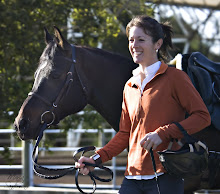

 Posts
Posts

