The topic of Love came up last week, which produced a sobering dose of self-reflection. It probably came up because it's the one thing that unites us all to the selfless and expensive concept of owning horses, an endeavor that leaves most of us asking "why do I do this?" far more often than answers that question.
It all started in the barn aisle when my student began philosophizing about the particular type of longing that afflicts her. It's the type that drags her to the barn even when she can't determine if she's having fun or not, the type that makes her feel like an addict struggling along for several weeks with frustrations and financial setbacks waiting for that next high. She stood wringing her hands and shaking her head.
"It's like chronically being in love with the bad boy in high school," she finally announced. Skeptical, I pondered her analogy, hoping of course to settle on a definition of desire that was lots more high-minded. Wasn't horsemanship, after all, a classical tradition with its roots in nobility and aristocracy? Surely, we were more sophisticated in our pursuit of it than sappy high school girls chasing after the unavailable football quarterback, no?
For my student, though, it felt like an affliction rather than affection and horses were that bad boy with low slung shoulders and a swagger, trapping her in a cycle of swooning-heartbreak-pursuit-swooning again.
Myself, I pondered a more idealistic and self-serving definition over the next days. If we were going to talk about Love, I hoped to believe that I had found the ultimately satisfying lifelong romance. Where some folks like my student might be chasing after the bad boy, I on the other hand had a passionate one-of-a-kind affair.
Right?
This begged for a description of the starting point. One cannot discuss Love without admitting where, when, and for whom the feelings first arose that made trumpets blare in one's chest and inspire lines of poetry and cause one to admit that he or she would never again be the same. Do me a favor and think about this yourself for a moment. My own pondering led me to a starkly juvenile confession: my version of Love was no more sophisticated than my student's. In fact, she now seemed like a Hollywood romance starlet while I belonged in a trashy tabloid, at best.
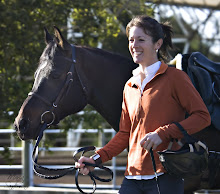
My first Love was a black mare named Sheba. I was six years old. I'm pretty sure my parents bought Sheba with the hopes that she might kill me or at the very least gallop into the next county and get me out of their hair.
In one word, Sheba was dreadful. She was mean, high-strung, prone to biting, and bucked off anyone who tried to ride her. I adored her. I couldn't get enough of the nasty little horse. I drew pictures for her, wrote my school reports about her, molded clay figurines of her. And of course I tried to show her off to all the neighbor kids.
I brushed and polished her smooth black coat until it shined like river silt. And then I mounted up and took off through Mr. Eddy's field which ran the length of West Street for a couple miles, allowing me to showcase my fine steed, and love of my life, at a full gallop to passers-by for as long as I could stay on. Of course, staying on Sheba was the tricky part. I generally only made it half-way down the field before Sheba dumped me right in front of my neighbor Jackie who was a fellow six-year old equestrian and rival of mine. In my many years of trying, I'm pretty sure I never succeeded in impressing Jackie with my riding nor my ruffian mount.
On one particular snowy December day, I set about my usual routine to impress Jackie with Sheba on my 300th attempt. A couple feet of snow covered Mr. Eddy's field, adding some beauty and drama to the scene, I thought, with a trill in my chest! Wait until Jackie saw us streaking through the snow at top speeds. If only I can stay on, if only I can stay on, I chanted. And then, in the demure way a high school prom queen begs her bad boy to stop ditching her and flirting with other girls, I buried my nose in Sheba's mane and asked her gently to please not throw me off. Just this once. Just today, okay? Feeling like we struck an agreement, I swung my leg over the saddle and we hit hypersonic speed within seconds. Snow flew around us and Sheba ran with every ounce of might in her body. What a feeling!, I marveled.
Jackie noticed us, too, and stopped in her driveway for a moment looking straight out at Mr. Eddy's field. Here is my chance at last, I shrieked into the storm. On this 300th attempt, Sheba then bucked and twisted so violently that I flew off the right side and caught my boot in the stirrup. She proceeded to gallop with me dangling upside down, my head and shoulders bumping along the ground, trying my best to turn away from her hooves. I tried repeatedly to break my foot loose from the stirrup but it wedged below the heel. I realized that I would either perish soon or eventually Sheba might stop running. But in either case, I would be dragged for a good long time. And I was.
Finally, Jackie- who for the record WAS very impressed by the spectacle, though not in the way I intended-- came to my rescue. She charged through the snow, jumped off a stone wall, and grabbed Sheba's reins to pull her to a stop. She said nothing, just made sure I was okay, which I more or less was except for a broken ego. I took Sheba's reins and limped alongside her up the road back to our barn reflecting on how closely I just came to breaking my neck. I expected to feel anger towards my demonic horse or feel sworn into being more cautious or maybe quitting horses altogether and finding a different interest.
But you know how it is when you're a sucker for the bad boy.
Later that night, I pulled out my quilted pink Holly Hobbie diary and wrote down the day's events. My mother still has this pathetic diary entry. It goes like this:
"Today, I rode Sheba in Mr. Eddy's field. It was snowing. She bucked me off. I was dragged. I love her."
Had I been a bit more foreseeing, I should have added "I am officially doomed for life with an incurable affliction, God save my soul."
Tuesday, January 26, 2010


Wednesday, December 2, 2009
High Maintenance
Without naming any particular facility, I will say that I found myself last week staring unabashedly at what can only be described as complete and utter disrepair. And, no, I was not at the county dump or the scene of an earthquake. Quite the contrary, I was at a place where folks pay big bucks to be. Or more accurately, they pay big bucks for their horses to be there.
Call me unrealistic or snobby, but in my opinion any place that shares a sentence with 'big bucks' should be of a certain decorum. I'm not instating high standards here; I'm just looking for basic infrastructure. Read as: fence posts that stand vertically to the ground rather than bending over in insect-riddled, rotting splinters; stall walls made from legitimate building materials instead of baling twine, hoses, cardboard; gates and cross-ties that actually latch; arenas without weeds growing in them. Stuff like this. For some reason, these requirements are becoming more difficult to find.
This situation gives my mother justification to say "I told you so." You see, I spent most of my childhood enslaved in what I believed to be a cruel regime of child labor (which meant I had a few chores around our New England horse farm) and whined constantly about the endless lists of things to be repaired, fixed, maintained. My mother used to chant her mantra "upkeep, upkeep, upkeep" around our farm, reminding us that, without constant maintenance, a farm would fall into disrepair faster than anyone suspected. I originally thought she herself was being a little high maintenance, but now I have to admit that she was right.
My brother and I formed a labor party of two at Maranatha Training Stables, my parents' farm. We did everything from prune our fruit orchard to stacking firewood to painting fence boards. We spent so much time painting pasture fences, in fact, that I occasionally still see white paddock fencing stretching for miles when I close my eyes. Of all the treasures on our farm, my mother was proudest of those wooden fences. Every board, every post, and every nail was painted a perfect white. Should a board get chewed on or kicked by a horse, her labor party (the aforementioned offspring) hustled out there with replacement lumber along with a pail of paint.
I will admit that 36 acres of this fencing IS a lovely sight. But the adult in me is the one who can admit this, the adult who suffers severe nostalgia for so much pristine perfection on a horse facility. The kid in me secretly hated that fencing. It meant nothing to me but achy wrists and paint gunked under my nails and hours of boring labor. What was the point in any of it? Wouldn't twine and duct tape and cardboard suffice for fencing AND be a lot easier?
Initially, my brother and I were paid-- if you can call microscopic figures that--by the hour. We earned something like $1 per hour for painting those never-ending fences and the task consumed our entire summer breaks from school. We tried convincing ourselves it was better than working at the video store or bagging groceries at the supermarket. But it wasn't until the end of summer that we made it better by sheer childhood cleverness. One day with his hand permanently frozen in a claw-like position from grasping the brush handle, my brother realized we would be paid the same amount per hour regardless how many sections of fencing we accomplished. So, why were we working so hard?, he mused? Why not just slack off? And that, gentle reader, is how an 8-year old and a 9-year old introduced themselves to often inefficient ways of capitalism.
Being the older wiser one, he convinced me that mom would never know our productivity had dropped off and we would still collect our $1 per hour. So, when we got out to the perimeter fencing of our property, most of it out of sight from the main barn or house, we would lay down our paint brushes and go skip stones in the creek. Or build bike jumps or collect grasshoppers. Shucking off the guilt that sometimes reared its head, we told ourselves that abandoning our job was just fine because, at the end of the day, all those perfectly white fences didn't really matter. Wouldn't twine and duct tape and cardboard suffice for fencing, anyway?
One sunny afternoon in August, we hid our paint cans and crawled into the expansive raspberry patch to take naps. We were asleep for probably two hours when a shadow slanted across our blissful sunshine and stirred us awake. And in our repose, we looked up to see my mother staring down at us. Needless to write, much lecturing ensued. The lengthy and sometimes poetic scolding covered the grounds of employee ethics, general good behavior, workmanship, etc. But my mother's primary disappointment came not from her children's sneaky ethics. More hurtful to her was the fact that we abandoned her prized white fences. She reminded us in the raspberry patch of their beauty, their value, their sheer aesthetic superiority to something like twine or cardboard.
For us, that afternoon fell into the category of moments where children think their parent is greatly over-reacting. I held that belief for a number of years, bolstered by the bitterness of having to give back most of my summer wages. In fact, I think I held onto the secret animosity towards those summers of white fence painting until just last week when I stood aghast at the dilapidation around me that qualified as a bona fide boarding facility. In that moment, I finally got my answer. NO, twine and duct tape and cardboard do not suffice as fencing. A familiar ache crept into my wrists briefly as I reflected on all those acres of white wooden fences at Maranatha Training Stables. I couldn't promise I'd be a more productive employee now than I was as a mischievously napping 8-year old, but something in me felt compelled to nail up some boards and brush paint across them. My chest tensed with urgency and excitement. White fences! Wooden boards!
Don't misunderstand me, I wouldn't wish to create a ritzy place that could justify charging boarders a fortune to be there. Nah, I might even charge less than the facilities falling into disrepair. I would just want visitors to pride me every day on the aesthetic superiority of my white fences.
Call me unrealistic or snobby, but in my opinion any place that shares a sentence with 'big bucks' should be of a certain decorum. I'm not instating high standards here; I'm just looking for basic infrastructure. Read as: fence posts that stand vertically to the ground rather than bending over in insect-riddled, rotting splinters; stall walls made from legitimate building materials instead of baling twine, hoses, cardboard; gates and cross-ties that actually latch; arenas without weeds growing in them. Stuff like this. For some reason, these requirements are becoming more difficult to find.
This situation gives my mother justification to say "I told you so." You see, I spent most of my childhood enslaved in what I believed to be a cruel regime of child labor (which meant I had a few chores around our New England horse farm) and whined constantly about the endless lists of things to be repaired, fixed, maintained. My mother used to chant her mantra "upkeep, upkeep, upkeep" around our farm, reminding us that, without constant maintenance, a farm would fall into disrepair faster than anyone suspected. I originally thought she herself was being a little high maintenance, but now I have to admit that she was right.
My brother and I formed a labor party of two at Maranatha Training Stables, my parents' farm. We did everything from prune our fruit orchard to stacking firewood to painting fence boards. We spent so much time painting pasture fences, in fact, that I occasionally still see white paddock fencing stretching for miles when I close my eyes. Of all the treasures on our farm, my mother was proudest of those wooden fences. Every board, every post, and every nail was painted a perfect white. Should a board get chewed on or kicked by a horse, her labor party (the aforementioned offspring) hustled out there with replacement lumber along with a pail of paint.
I will admit that 36 acres of this fencing IS a lovely sight. But the adult in me is the one who can admit this, the adult who suffers severe nostalgia for so much pristine perfection on a horse facility. The kid in me secretly hated that fencing. It meant nothing to me but achy wrists and paint gunked under my nails and hours of boring labor. What was the point in any of it? Wouldn't twine and duct tape and cardboard suffice for fencing AND be a lot easier?
Initially, my brother and I were paid-- if you can call microscopic figures that--by the hour. We earned something like $1 per hour for painting those never-ending fences and the task consumed our entire summer breaks from school. We tried convincing ourselves it was better than working at the video store or bagging groceries at the supermarket. But it wasn't until the end of summer that we made it better by sheer childhood cleverness. One day with his hand permanently frozen in a claw-like position from grasping the brush handle, my brother realized we would be paid the same amount per hour regardless how many sections of fencing we accomplished. So, why were we working so hard?, he mused? Why not just slack off? And that, gentle reader, is how an 8-year old and a 9-year old introduced themselves to often inefficient ways of capitalism.
Being the older wiser one, he convinced me that mom would never know our productivity had dropped off and we would still collect our $1 per hour. So, when we got out to the perimeter fencing of our property, most of it out of sight from the main barn or house, we would lay down our paint brushes and go skip stones in the creek. Or build bike jumps or collect grasshoppers. Shucking off the guilt that sometimes reared its head, we told ourselves that abandoning our job was just fine because, at the end of the day, all those perfectly white fences didn't really matter. Wouldn't twine and duct tape and cardboard suffice for fencing, anyway?
One sunny afternoon in August, we hid our paint cans and crawled into the expansive raspberry patch to take naps. We were asleep for probably two hours when a shadow slanted across our blissful sunshine and stirred us awake. And in our repose, we looked up to see my mother staring down at us. Needless to write, much lecturing ensued. The lengthy and sometimes poetic scolding covered the grounds of employee ethics, general good behavior, workmanship, etc. But my mother's primary disappointment came not from her children's sneaky ethics. More hurtful to her was the fact that we abandoned her prized white fences. She reminded us in the raspberry patch of their beauty, their value, their sheer aesthetic superiority to something like twine or cardboard.
For us, that afternoon fell into the category of moments where children think their parent is greatly over-reacting. I held that belief for a number of years, bolstered by the bitterness of having to give back most of my summer wages. In fact, I think I held onto the secret animosity towards those summers of white fence painting until just last week when I stood aghast at the dilapidation around me that qualified as a bona fide boarding facility. In that moment, I finally got my answer. NO, twine and duct tape and cardboard do not suffice as fencing. A familiar ache crept into my wrists briefly as I reflected on all those acres of white wooden fences at Maranatha Training Stables. I couldn't promise I'd be a more productive employee now than I was as a mischievously napping 8-year old, but something in me felt compelled to nail up some boards and brush paint across them. My chest tensed with urgency and excitement. White fences! Wooden boards!
Don't misunderstand me, I wouldn't wish to create a ritzy place that could justify charging boarders a fortune to be there. Nah, I might even charge less than the facilities falling into disrepair. I would just want visitors to pride me every day on the aesthetic superiority of my white fences.
Sunday, November 8, 2009
Free Horses and Empty Wallets
$10,000 is the amount I spent last year on a free horse. And hopefully you detect the irony in that sentence. Free and $10K don't exactly belong together. But I ignored my own basic operating rules during a six month period of psychological weakness last summer and chose to wave off the age-old truth that there is no such thing as a free horse.
Let my own stupidity serve a message to readers that there really IS no such thing as free when horses are involved. Don't get me wrong-- there are plenty of horses with no purchase prices that are simply free to a good home. Purchase prices, though, pale in comparison to what folks will end up spending over a few months of basic care for a horse. Take my own scenario as an example. Rule #1 in this situation I like to call "Foolishly Believing in Free" says when something seems too good to be true, it is.
Last April, my friend and I received a call from a distressed trainer who allegedly owned a talented, beautiful, sweet-tempered Warmblood gelding that she needed to find a (free) home for because her life was in turmoil and she could no longer care for him. Reeking of suspicion, the offer to acquire her Olympic caliber mount at no cost seemed a wee too good to be true. So, we declined the offer to take him. But a few days later, we received another call from the trainer, this time from her cell phone. Apparently, she was en route to our barn already, declining to take our "no" as an answer for her super talented free Warmblood. She had him in the trailer and would be at our place in an hour.
Hmm. A free horse and free delivery? Now, things definitely smelled fishy. But my friend and I, two softies at heart, wondered what the worst possible outcome could be for this story. Plus, I've always been the hard-headed type that likes to disprove adages to which everyone else submits. Maybe I'd show the world that there is such a thing as a free horse!
Meanwhile, we brainstormed why this particular talented and beautiful horse might be free, trying to ready ourselves for his arrival in our driveway. Maybe he had a few lameness issues, which may explain his unsolicited gifting upon us. But we figured at the very least, he could be a moderately sound-- and gorgeous-- trail mount. Or perhaps he could be used as a lesson horse and actually earn us a few bucks. Or maybe, just maybe, he would indeed be everything he was promised and my friend and I now owned the horse we always dreamed about but could never afford!
The horse-- let's call him Wolfgang-- blasted out of the trailer on his hind legs and proceeded to wreak havoc on the courtyard despite his handler's yanking and pulling on the chain that encircled his head and nose. At this point, I should have demanded the horse be loaded back into the trailer and driven out of my sight and life for good. But here is where the frail shards of blind optimism surrounding receipt of something potentially awesome for free rears their hideous heads. Undeniably terrified of the rearing beast in our driveway that now strangely belonged to us, my friend and I looked at each other. And embarrassingly, I will admit that we both wore an expression that said the same thing: wow, this might be everything we've ever dreamed about... and for free!
Where we should have seen nothing but danger and rotten luck, we saw good fortune.
This is the type of delusional thinking that constitutes rule #2 in "Foolishly Believing in Free."
After tearing apart a section of fencing with his flailing front legs, nearly killing a neighbor's dog, and destroying our newly seeded lawn with nervously prancing hooves, Wolfgang was wrestled into a stall for the night. It was the last free night of our lives. From the next morning forward, we adopted a new pastime of writing checks to cover Wolfgang's expenses. In fact, we almost couldn't write checks fast enough to keep pace with his need. First, his metabolism proved impossible to satiate and we spent more money on his hay, grain, and rice bran than on our own mortgage. His ribs still stuck out at the end of our first month, prompting us to try costly detox supplements in the event he carried a parasite or other health anomaly that prevented him from putting on weight.
When the detox supplements failed, we tried a treatment of acupuncture that made the previous supplements seem reasonably priced. When acupuncture failed, we gave up and accepted that he might always be underweight. Plus, by then we had to direct our waning funds to more pressing matters, such as his training problems. Wolfgang was a gigantic animal, standing well over 17 hands with an immense neck that rose straight up to the sky. In his 10 years of life, nobody had taken the time to teach him basic manners. We found it impossible to lead him from Point A to Point B without incurring bodily harm. Not only was he gigantic and unruly, he was also spooky at just about everything. Every 30 seconds or so, he lurched in fright at something or other, snorted from his nose, and pranced himself into a sweaty mess. Rustling bushes, mundane noises, drizzly weather, crunchy leaves all became our nemesis.
After six months of buying new equipment to replace what Wolfgang broke-- halters, leadlines, feeding tubs, my toe-- we decided he needed to get some rudimentary training pronto. One morning we set about the task of loading him into our trailer and taking him for training to a cowboy a few towns over. That afternoon, we were still trying to get him in the rig. By nightfall, we gave up. Wolfgang would not step foot near the trailer. He reared, he ran backwards, he stomped his feet and threw his head. No problem, we thought, the trailer may seem confining to him. So the next day we plunked down a hefty fee to rent a spacious and airy trailer. We payed the small fortune in gas for a round trip to pick it up an hour away and then began again our challenge of getting Wolfgang to load up. We repeated this for three days before admitting we needed reinforcements. At this point, my hard-headiness around ignoring adages felt like plain old hubris.
After a bit of research, we found a Mustang wrangler who was able to tame wild horses and get them to walk comfortably into her trailer out in the Nevada desert. Aha, we thought, this was our gal! She charged-- of course-- a mighty sum of money but promised to get our deranged Warmblood into the trailer without cruelty or drugs. And sure enough she did. It took her about four hours and her whole bag of tricks for working with wild horses. Now after four and a half days of our endeavor to get Wolfgang on the trailer, my friend and I realized we had spent every last dime between us. The horse was in the trailer, but now what?
This is when a person encounters rule #3 in "Foolishly Believing in Free"--you concede to your own original ignorance. In my case, I had to admit that adages exist for a reason. And yes, dear reader, I learned first-hand that there really IS no such thing as a free horse. In fact, I would venture to say I didn't just learn this; I had it repeatedly pounded into my thick skull day after day after day. Which seems to be the only way folks learn things in the horse world.
Time-tested truths from expert sources just don't seem to be enough for us horsey folks. We like to learn things the hard way, wittling down our savings accounts until we are financially bludgeoned into admitting we should have listened to that sage advice in the first place. But nothing speaks to us and illustrates our follies like our own empty wallets. So, even though you will likely not heed my advice, I'm giving it to you anyway: When someone offers you a free horse, run the opposite direction very fast!
Let my own stupidity serve a message to readers that there really IS no such thing as free when horses are involved. Don't get me wrong-- there are plenty of horses with no purchase prices that are simply free to a good home. Purchase prices, though, pale in comparison to what folks will end up spending over a few months of basic care for a horse. Take my own scenario as an example. Rule #1 in this situation I like to call "Foolishly Believing in Free" says when something seems too good to be true, it is.
Last April, my friend and I received a call from a distressed trainer who allegedly owned a talented, beautiful, sweet-tempered Warmblood gelding that she needed to find a (free) home for because her life was in turmoil and she could no longer care for him. Reeking of suspicion, the offer to acquire her Olympic caliber mount at no cost seemed a wee too good to be true. So, we declined the offer to take him. But a few days later, we received another call from the trainer, this time from her cell phone. Apparently, she was en route to our barn already, declining to take our "no" as an answer for her super talented free Warmblood. She had him in the trailer and would be at our place in an hour.
Hmm. A free horse and free delivery? Now, things definitely smelled fishy. But my friend and I, two softies at heart, wondered what the worst possible outcome could be for this story. Plus, I've always been the hard-headed type that likes to disprove adages to which everyone else submits. Maybe I'd show the world that there is such a thing as a free horse!
Meanwhile, we brainstormed why this particular talented and beautiful horse might be free, trying to ready ourselves for his arrival in our driveway. Maybe he had a few lameness issues, which may explain his unsolicited gifting upon us. But we figured at the very least, he could be a moderately sound-- and gorgeous-- trail mount. Or perhaps he could be used as a lesson horse and actually earn us a few bucks. Or maybe, just maybe, he would indeed be everything he was promised and my friend and I now owned the horse we always dreamed about but could never afford!
The horse-- let's call him Wolfgang-- blasted out of the trailer on his hind legs and proceeded to wreak havoc on the courtyard despite his handler's yanking and pulling on the chain that encircled his head and nose. At this point, I should have demanded the horse be loaded back into the trailer and driven out of my sight and life for good. But here is where the frail shards of blind optimism surrounding receipt of something potentially awesome for free rears their hideous heads. Undeniably terrified of the rearing beast in our driveway that now strangely belonged to us, my friend and I looked at each other. And embarrassingly, I will admit that we both wore an expression that said the same thing: wow, this might be everything we've ever dreamed about... and for free!
Where we should have seen nothing but danger and rotten luck, we saw good fortune.
This is the type of delusional thinking that constitutes rule #2 in "Foolishly Believing in Free."
After tearing apart a section of fencing with his flailing front legs, nearly killing a neighbor's dog, and destroying our newly seeded lawn with nervously prancing hooves, Wolfgang was wrestled into a stall for the night. It was the last free night of our lives. From the next morning forward, we adopted a new pastime of writing checks to cover Wolfgang's expenses. In fact, we almost couldn't write checks fast enough to keep pace with his need. First, his metabolism proved impossible to satiate and we spent more money on his hay, grain, and rice bran than on our own mortgage. His ribs still stuck out at the end of our first month, prompting us to try costly detox supplements in the event he carried a parasite or other health anomaly that prevented him from putting on weight.
When the detox supplements failed, we tried a treatment of acupuncture that made the previous supplements seem reasonably priced. When acupuncture failed, we gave up and accepted that he might always be underweight. Plus, by then we had to direct our waning funds to more pressing matters, such as his training problems. Wolfgang was a gigantic animal, standing well over 17 hands with an immense neck that rose straight up to the sky. In his 10 years of life, nobody had taken the time to teach him basic manners. We found it impossible to lead him from Point A to Point B without incurring bodily harm. Not only was he gigantic and unruly, he was also spooky at just about everything. Every 30 seconds or so, he lurched in fright at something or other, snorted from his nose, and pranced himself into a sweaty mess. Rustling bushes, mundane noises, drizzly weather, crunchy leaves all became our nemesis.
After six months of buying new equipment to replace what Wolfgang broke-- halters, leadlines, feeding tubs, my toe-- we decided he needed to get some rudimentary training pronto. One morning we set about the task of loading him into our trailer and taking him for training to a cowboy a few towns over. That afternoon, we were still trying to get him in the rig. By nightfall, we gave up. Wolfgang would not step foot near the trailer. He reared, he ran backwards, he stomped his feet and threw his head. No problem, we thought, the trailer may seem confining to him. So the next day we plunked down a hefty fee to rent a spacious and airy trailer. We payed the small fortune in gas for a round trip to pick it up an hour away and then began again our challenge of getting Wolfgang to load up. We repeated this for three days before admitting we needed reinforcements. At this point, my hard-headiness around ignoring adages felt like plain old hubris.
After a bit of research, we found a Mustang wrangler who was able to tame wild horses and get them to walk comfortably into her trailer out in the Nevada desert. Aha, we thought, this was our gal! She charged-- of course-- a mighty sum of money but promised to get our deranged Warmblood into the trailer without cruelty or drugs. And sure enough she did. It took her about four hours and her whole bag of tricks for working with wild horses. Now after four and a half days of our endeavor to get Wolfgang on the trailer, my friend and I realized we had spent every last dime between us. The horse was in the trailer, but now what?
This is when a person encounters rule #3 in "Foolishly Believing in Free"--you concede to your own original ignorance. In my case, I had to admit that adages exist for a reason. And yes, dear reader, I learned first-hand that there really IS no such thing as a free horse. In fact, I would venture to say I didn't just learn this; I had it repeatedly pounded into my thick skull day after day after day. Which seems to be the only way folks learn things in the horse world.
Time-tested truths from expert sources just don't seem to be enough for us horsey folks. We like to learn things the hard way, wittling down our savings accounts until we are financially bludgeoned into admitting we should have listened to that sage advice in the first place. But nothing speaks to us and illustrates our follies like our own empty wallets. So, even though you will likely not heed my advice, I'm giving it to you anyway: When someone offers you a free horse, run the opposite direction very fast!
Subscribe to:
Posts (Atom)



 Posts
Posts

